 Ask AI
PowerFlow block reference
Last updated: Sep-28-2026
As explained in Build a PowerFlow, PowerFlows are composed of a set of blocks that are connected together, creating step-by-step actions to execute. Each block performs a specific function. Blocks are grouped into different categories to make them more accessible. A block can belong to more than one category, so in the Add a block dialog you'll find it under each category that applies. On this page, each block is documented once, under its main category.
In the configuration table for each block, Yes* in the Required column marks a field that's conditionally required, with the condition given in the field's description. Most often it means you either select an asset from a previous block, pick a fixed asset from your Media Library, or provide the asset details yourself.
Triggers
Flows in MediaFlows start with Trigger Blocks, which define how and when a flow is initiated. Triggers can be event-driven (e.g., a webhook call, an asset upload) or time-based (e.g., a scheduled task). Each flow must begin with a trigger block.
On Asset Upload
Starts the flow whenever an asset is uploaded to Cloudinary.
Configuration
| Field | Type | Required | Description |
|---|---|---|---|
| Asset filter | Asset filter | No | Configure conditions to trigger the flow only for specific assets. When Trigger for any asset is selected, no filter is applied. Otherwise, filter by Asset type (image, video, raw), Tags (with operators like is any of, is all of, are empty, aren't empty), Structured metadata (specific metadata fields and values), or Folders (exact folder or including subfolders). Turn on Advanced filtering to write a JsonLogic expression instead of using the guided builder. |
| Webhook URL | Text | No | The unique webhook URL to send requests to. |
Example use case
When an image is uploaded by a third party, automatically check if it contains a watermark.
On Folder Change
Starts the flow when a user moves an asset between folders in Cloudinary.
Configuration
| Field | Type | Required | Description |
|---|---|---|---|
| From folder | Folder filter | No | Specify the source folder from which assets are moved. First, choose an operator, then select a folder from your account. Options: Is, Is, or is a subfolder of
|
| To folder | Folder filter | No | Specify the destination folder to which assets are moved. First, choose an operator, then select a folder from your account. Options: Is, Is, or is a subfolder of
|
| Asset filter | Asset filter | No | Configure conditions to trigger the flow only for specific assets. When Trigger for any asset is selected, no filter is applied. Otherwise, filter by Asset type (image, video, raw), Tags (with operators like is any of, is all of, are empty, aren't empty), Structured metadata (specific metadata fields and values), or Folders (exact folder or including subfolders). Use Add Condition to combine multiple criteria. Turn on Advanced filtering to write a JsonLogic expression instead of using the guided builder. |
Example use cases
- Moving an image from any folder into an "Approved" folder triggers a transformation process.
- Moving a video asset from "Draft" to "Published" triggers a notification workflow.
- Not supported for product environments using the legacy fixed folder mode.
- In legacy mode, moving an asset changes its
public_id, triggering a rename notification instead.
On Manual Run From Media Library
Starts the flow manually from assets you select in the Cloudinary Media Library. Turn on batch execution to process all the selected assets in a single flow run.
Configuration
| Field | Type | Required | Description |
|---|---|---|---|
| Description | Text | No | A short description of the flow to appear in the MediaFlows DAM App. |
| Return results as array | Toggle | No | Enable this if you want the output to be returned as an array. If disabled, the block is executed for each selected asset. |
| Input parameters | Multi-input variable | No | The input parameters that users can set when running the flow. For each parameter, enter a name and select a type (Text, Number, Boolean, or Folder). Subsequent blocks can access them as custom variables. |
Run the app
- Navigate to your Media Library in Assets.
-
Either select one asset and click Run Automation from the (3-dots) context menu on the asset, or select multiple assets, and in the assets toolbar click Run Automation. Then choose the flow that you want to trigger.


Example use case
A user manually selects some images in the Cloudinary Media Library and triggers a flow. In a prompt parameter they ask the same question about each of the images and the app sets the answer for each image in its metadata.
On Notification Received
Starts the flow when Cloudinary sends one or more of the webhook notifications you select. It's useful for notifications that don't have dedicated trigger blocks already defined, or if you want to set up one trigger for multiple notifications.
Configuration
| Field | Type | Required | Description |
|---|---|---|---|
| Notification event | Multi-select | No | Select the type of event that should trigger this webhook. Options: Upload, Move, Delete, Resource display name changed, Resource context changed, Resource metadata changed, Access control changed, Create folder, Delete folder, Rename, Resource tags changed, Move or rename asset folder, Moderation, Restore asset version
|
| Advanced filter | Code | No | Optionally restrict the trigger with a JsonLogic expression evaluated against the notification's webhook payload (for example, { "==": [ { "var": "resource_type" }, "image" ] }). Leave empty to trigger for every selected event. Invalid input shows a warning but doesn't block saving. |
Example use case
A flow starts when a user moves an asset to a folder or uploads an asset to a folder.
- Some notifications may not be available for product environments using the legacy fixed folder mode.
- The structure of each notification is different so you need to take multiple structures into consideration.
On Proof Status Change
Starts the flow when a final decision is reached on a proof in a Creative Approval flow. Your flow runs separately for each asset in the proof that meets the filter criteria.
Configuration
| Field | Type | Required | Description |
|---|---|---|---|
| Proof status filter | Proof status filter | No | Configure when the trigger runs based on proof status and Creative Approval flow: - When proof status is set to: Select which status changes trigger the flow. Options: Any Status, Decision pending, Approved, Approved with changes, Changes required, Not relevant- Trigger for these Creative Approval flows: Select specific flows or choose Any Flow to trigger on all approval flows. |
| Asset filter | Asset filter | No | Configure conditions to trigger the flow only for specific assets. When Trigger for any asset is selected, no filter is applied. Otherwise, filter by Asset type (image, video, raw), Tags (with operators like is any of, is all of, are empty, aren't empty), Structured metadata (specific metadata fields and values), or Folders (exact folder or including subfolders). Turn on Advanced filtering to write a JsonLogic expression instead of using the guided builder. |
| Webhook URL | Text | No | The unique webhook URL to send requests to. |
Example use cases
- When a proof is approved, automatically move all images in the proof to a "Ready for production" folder and update their structured metadata.
- When a proof requires changes, restrict access control and move the assets to a revision folder.
- Creative Approval Flows Admin Guide - Learn how to set up and manage approval flows.
- Understanding proof decision calculation - Learn how proof decisions are calculated based on reviewer decisions.
On Schedule
Starts the flow at predefined time intervals, similar to a cron job.
Configuration
| Field | Type | Required | Description |
|---|---|---|---|
| Recurring schedule | Cron schedule | No | How often the flow runs. Use the guided builder to set the frequency (for example, every hour, or every Monday at a specific time) without writing raw cron syntax. Switch to advanced mode to enter a cron expression directly. |
Example use case
Send a daily report on your account usage.
Example cron expressions
If you switch to advanced mode, you can enter a cron expression directly. The expression is interpreted in UTC.
| Scenario | AWS cron expression |
|---|---|
| Run every day at 10:00 AM UTC | 0 10 * * ? * |
| Run every Monday at 2:00 PM UTC | 0 14 ? * MON * |
| Run once per hour | 0 * * * ? * |
On Scheduled Search
Starts the flow on a predefined schedule, searching for assets that match criteria you set and running the blocks that follow for each asset it finds.
The flow works on 50 results at a time, in parallel, so the logs may show multiple executions for the same trigger, each with a maximum of 50 assets. There's no limit on the total number of assets a flow processes, but you can set a smaller maximum to process a sample first while building and testing the flow.
Configuration
| Field | Type | Required | Description |
|---|---|---|---|
| Recurring schedule | Cron schedule | Yes | How often the scheduled search runs. Use the guided builder to set the frequency (for example, every hour, or every Monday at a specific time) without writing raw cron syntax. Switch to advanced mode to enter a cron expression directly. |
| Assets to search for | Text | Yes | Define which assets to search for, using a Lucene-like expression. See search expressions for syntax details. |
| Include asset metadata | Toggle | No | Also fetch the metadata saved on each asset. |
| Sort by | Dropdown | No | Choose which asset property determines the processing order. Options: created_at, uploaded_at, public_id, filename, format, resource_type, type, bytes, width, height, aspect_ratio, pixels, duration, folder, scorefilename is the last segment of the public ID, without the folder path or file extension. |
| Sort order | Dropdown | No | Process results in ascending or descending order. Options: asc, desc
|
| Maximum assets to process | Number | No | Stop after processing this many matching assets. Default: 15000
|
Example use case
Each day, apply a transformation to all assets uploaded in the last 24 hours.
Example cron expressions
If you switch to advanced mode, you can enter a cron expression directly. The expression is interpreted in UTC.
| Scenario | AWS cron expression |
|---|---|
| Run every day at 10:00 AM UTC | 0 10 * * ? * |
| Run every Monday at 2:00 PM UTC | 0 14 ? * MON * |
| Run once per hour | 0 * * * ? * |
Example search expressions
| Use case | Search expression |
|---|---|
| Find all assets in "products" with the tag "spring_collection" | folder=products AND tags=spring_collection |
| Find all assets that are of type "video" | resource_type=video |
On Structured Metadata Change
Starts the flow when an asset's structured metadata is modified.
Configuration
| Field | Type | Required | Description |
|---|---|---|---|
| Structured metadata filter | Structured metadata filter | No | Configure when to trigger based on structured metadata changes. When Trigger for any structured metadata change is selected, all metadata changes trigger the flow. Otherwise, specify a metadata field, choose an operator, and enter or select the values to filter on. The operators available depend on the field type:
|
| Asset filter | Asset filter | No | Configure conditions to trigger the flow only for specific assets. When Trigger for any asset is selected, no filter is applied. Otherwise, filter by Asset type (image, video, raw), Tags (with operators like is any of, is all of, are empty, aren't empty), Structured metadata (specific metadata fields and values), or Folders (exact folder or including subfolders). Use Add Condition to combine multiple criteria. Turn on Advanced filtering to write a JsonLogic expression instead of using the guided builder. |
- isn't empty triggers only when the field changes from empty to having a value. If the field already has a value, changing it to another value doesn't trigger the flow.
- is empty triggers only when a field that had a value is cleared.
- All other operators trigger when the field's new value matches the condition and is different from its previous value.
Example use cases
- When an asset's "Status" metadata field changes to "Archived," move it to a designated folder.
- When the "Moderation Source" metadata is set to "Automatic," trigger an automated approval workflow.
On Tag Change
Starts the flow when a tag is added to or removed from an asset in Cloudinary.
Configuration
| Field | Type | Required | Description |
|---|---|---|---|
| Tag filter | Tag filter | No | Configure when to trigger based on tag changes. When Trigger when any tag is added or removed is selected, all tag changes trigger the flow. Otherwise, specify an operator, enter one or more tags, and choose an action. Tag operators: All of these, Any of theseActions: Added, Removed
|
| Asset filter | Asset filter | No | Configure conditions to trigger the flow only for specific assets. When Trigger for any asset is selected, no filter is applied. Otherwise, filter by Asset type (image, video, raw), Tags (with operators like is any of, is all of, are empty, aren't empty), Structured metadata (specific metadata fields and values), or Folders (exact folder or including subfolders). Use Add Condition to combine multiple criteria. Turn on Advanced filtering to write a JsonLogic expression instead of using the guided builder. |
Example use cases
- When the tag "featured" is added to an asset, automatically generate social media versions.
- When any tag is removed from a video asset, send a notification to the content team.
On Trigger From Another Flow
Starts the flow when another flow calls it using a Trigger Another Flow block.
Configuration
| Field | Type | Required | Description |
|---|---|---|---|
| Triggered by these flows | Multi-select | No | The flows that are allowed to trigger this flow. Click Add more, then select a flow from the dropdown, or click Custom to manually enter the flow ID. Repeat to allow more flows. |
| Custom data keys | Multi-input | No | The keys of the custom data sent by the Trigger Another Flow block that you want to use in later blocks, for example order_id or status. Click Add more and enter the key in Key to expose. Each key you add is available to later blocks as a dynamic parameter. |
Example use case
Create a reusable "watermarking" flow that can be triggered from multiple other flows, each handling different asset types.
On Upload With Preset
Starts the flow whenever an asset is uploaded to Cloudinary using certain upload presets. Using this block overwrites existing notification URLs on the selected presets.
Configuration
| Field | Type | Required | Description |
|---|---|---|---|
| Trigger this flow whenever an asset is uploaded to Cloudinary using one of the following upload presets | Upload presets | Yes | Choose one or more upload presets. The flow runs when an asset is uploaded using any of the selected presets. |
| Asset filter | Asset filter | No | Configure conditions to trigger the flow only for specific assets. When Trigger for any asset is selected, no filter is applied. Otherwise, filter by Asset type (image, video, raw), Tags (with operators like is any of, is all of, are empty, aren't empty), Structured metadata (specific metadata fields and values), or Folders (exact folder or including subfolders). Turn on Advanced filtering to write a JsonLogic expression instead of using the guided builder. |
| Webhook URL | Text | No | The unique webhook URL to send requests to. |

Example use case
When an image is uploaded using the "product_images" upload preset, automatically tag it with product metadata and run quality checks.
On Webhook Received
Starts the flow when an HTTP request is received at a specific webhook URL, so external applications can start flows in MediaFlows.
Configuration
| Field | Type | Required | Description |
|---|---|---|---|
| Webhook URL | Text | No | The unique webhook URL to send requests to. |
| Payload fields to expose | Multi-value text | No | Enter fields from the webhook payload to use in later blocks. For example: notification_type or response.public_id. |
Example use case
A custom CMS sends a webhook to MediaFlows when an asset is updated. The flow checks the notification_type to determine whether the asset was tagged, renamed, or moved, and routes the logic accordingly.
Flow Logic
These blocks can be used by any flow to implement logical flow functionality.
Branch On Condition
Sends your flow down one of two paths, depending on a condition you set, so you can react differently to different data.
Keep Advanced condition off to build your condition from simple, guided fields. Turn it on when you need extra power and want to write a JsonLogic expression yourself.
Configuration
| Field | Type | Required | Description |
|---|---|---|---|
| Advanced condition | Toggle | No | Off: build the condition from guided fields (Simple mode). On: write a JsonLogic expression (Advanced mode). Default: off. |
Simple mode
Build one or more condition rows. The flow follows the true path only when every row matches, all rows are joined with AND.
| Field | Type | Required | Description |
|---|---|---|---|
| Value type | Dropdown | No | The kind of data being compared. Determines the available operators and how both values are read. There's no default: until you pick one, the row shows only Value type and Value. Options: String, Number, Boolean, Date, Array
|
| Value | Text | No | The value to check. Usually a dynamic parameter from a previous block. |
| Operator | Dropdown | No | How to compare the two values. The available options depend on Value type (see the tables below). |
| Compare to | Text | No | The value to compare against. Hidden for Boolean and for the is empty / isn't empty operators. For an array, use a JSON array or a comma-separated list. For a date, use just the date or a full date and time, for example 2026-07-31 or 2026-07-31T14:23:05Z. |
Click Add more to add another condition row.
Operators available per value type:
| Value type | Operators |
|---|---|
| String |
is equal to, isn't equal to, contains, doesn't contain, starts with, ends with, is empty, isn't empty
|
| Number |
is equal to, isn't equal to, is greater than, is greater than or equal to, is smaller than, is smaller than or equal to, is empty, isn't empty
|
| Boolean |
is true, is false
|
| Date |
is, is after, is on or after, is before, is on or before, is empty, isn't empty
|
| Array |
contains, doesn't contain, has length equal to, is empty, isn't empty
|
For a date, write either just the date (for example 2026-07-31) or a full date and time with a time zone (for example 2026-07-31T14:23:05Z). A date on its own matches the whole day, in UTC, so is 2026-07-31 matches a value timestamped anytime that day.
is true / is false accept true/false, "true"/"false", and 1/0, and throw an error on anything else, including an unresolved dynamic parameter. is empty / isn't empty only check whether a value is present, they don't validate the value's format, so isn't empty is true for any non-blank value, valid or not.
Advanced mode
| Field | Type | Required | Description |
|---|---|---|---|
| JSON data | Text | No | The JSON object that {"var": ...} reads from, typically a previous block's output. With an upload result here, {"var": "width"} is its width and {"var": ""} is the whole object. Leave empty if the expression only uses dynamic parameters. |
| JsonLogic expression | Code | Yes | A JsonLogic expression that returns true or false. Read a field of JSON data with {"var": "width"}, or take a value straight from another block with a dynamic parameter kept inside quotes. |
(e.g.,
"text": "\\{\\{DATE(2017-02-14T06:08:39Z,SHORT)\\}\\}").{"var": "..."} whenever your expression reads several fields from one object, or uses the presence, array, or date operators below, since those need the object's real types (a number, an array) rather than dynamic parameters interpolated as text. For a single comparison against one dynamic parameter, it's simpler to leave JSON data empty and inline the parameter directly in the expression.Date format
The rules below apply to every date, in either mode: Simple mode's Value and Compare to fields when Value type is Date, and Advanced mode's date* operators.
Dates must be written as an RFC 3339 date-time, the format every Cloudinary API already uses, or as a date on its own with no time. Dynamic parameters from Cloudinary responses (for example, the Admin API's created_at or a webhook's triggered_at) are already in RFC 3339 format and need no reformatting.
-
Date only, for example
2026-07-31: interpreted as that whole day, in UTC. -
Date and time, UTC, for example
2026-07-31T14:23:05Z: interpreted as that exact moment. -
Date and time, with offset, for example
2026-07-31T14:23:05+05:30: interpreted as that exact moment. -
Fractional seconds (any precision), for example
2026-07-31T14:23:05.272126Z: interpreted as that exact moment.
A time zone, either Z or a numeric offset like +05:30, is required whenever a time is included, and seconds are required too. Lowercase t and z are also accepted.
Everything is evaluated in UTC. If either side of a comparison has no time, the two are compared as whole UTC days. If both sides include a time, full precision is used. So a value of 2026-07-31T14:23:05Z compared against the date-only 2026-07-31 matches is, is on or after, and is on or before (same day counts as "on"), but not is after or is before (the value falls during that day, not after or before it). Comparing two full timestamps keeps full precision: 14:23:05Z is 09:00:00Z on the same day is false.
2026-07-31. To compare down to the second, include the time and time zone. In Advanced mode, negating a date* operator gives you the "isn't" that Simple mode lacks, for example {"!": {"dateIs": [{"var": "created_at"}, "2026-07-31"]}}.Dates not written in one of the forms above are rejected with an error rather than guessed at. This includes slash-separated dates like 1/3/1990: they're ambiguous between day-first and month-first, and accepting them risks silently taking the wrong path rather than surfacing an error. Also rejected: a time without a time zone, a year or year-month alone, other ISO 8601 variants (like basic format or week dates), epoch timestamps, and dates that don't exist (like 2026-02-30).
Custom operators
Advanced mode supports the standard JsonLogic operator set, plus the following custom operators:
| Operator | Example | Description |
|---|---|---|
exists |
{"exists": "height"} |
True whenever the field is present, whatever it holds. null, 0, false, and "" all count as present. Takes a dot path (context.custom.alt, tags.0), or a list of paths where all must be present ({"exists": ["height", "width"]}). Negate with {"!": {"exists": "height"}}. |
dateIs, dateAfter, dateOnOrAfter, dateBefore, dateOnOrBefore
|
{"dateAfter": [{"var": "created_at"}, "2026-07-31"]} |
Compare two dates as moments in time. See Date format above. |
dateFromToday |
{"dateFromToday": {"offsetUnit": "day", "operator": "-", "offset": 7}} |
Today shifted by an interval, returned as a date-only value. The only way to express a relative date like "in the last 7 days," since neither mode otherwise has access to the current date. offsetUnit accepts day, week, month, or year; operator is + or -. Always pair it with a date* operator. |
arrayContains, arrayNotContains
|
{"arrayContains": [{"var": "tags"}, "hero"]} |
List membership. Accepts a real array, a JSON array string, or a comma-separated string, and matches members as text. |
arrayLength |
{">": [{"arrayLength": {"var": "tags"}}, 2]} |
The number of items in a list, as a number, so it composes with any numeric operator. An absent list counts as length 0. |
arraySameItems |
{"arraySameItems": [{"var": "a"}, {"var": "b"}]} |
True when both lists hold the same items, in any order, duplicates included. |
stringMatchesRegex |
{"stringMatchesRegex": [{"var": "public_id"}, "^hero-"]} |
Tests a value against a regular expression (not a substring match), compiled with the g, m, and u flags. |
- Use the
date*operators above, not the standard==,>, or<comparisons, to compare dates. JsonLogic has no concept of a date: its comparison operators run a plain character-by-character text comparison on the two strings, which only matches real chronology when both values share an identical format and time zone. For example, fractional seconds sort before whole seconds for the same instant (since.sorts beforeZ), and two different spellings of the same time-zone offset can compare as unequal. - The block routes on a boolean, so a JsonLogic expression that evaluates to anything else, a string, a number, or an array, fails the flow with a runtime error instead of taking the false path. This is most likely with the standard
missingoperator, which returns an array rather than a boolean: useexistsinstead. Simple mode always produces a real boolean and can't hit this.
Example use case
Only continue the flow if an asset is in a specific folder, or was uploaded in the last 7 days.
Output paths
- Yes → Block connected to the output labeled Yes executes.
- No → Block connected to the output labeled No executes.
Example JsonLogic
Each example below uses either JSON data and {"var": "..."}, or a dynamic parameter inline in the expression, following the guidance in Advanced mode above: use JSON data for several fields from one object or for the presence, array, and date operators; inline a dynamic parameter for a single one-off comparison.
Example 1: Only continue for assets uploaded in the last 7 days (inline dynamic parameter)
Example 2: Only continue for large, landscape images (JSON data)
Example 3: Check results from AI moderation by prompts (inline dynamic parameter)
Example 4: Check if an image is grayscale (inline dynamic parameter)
Repeat For Each Asset
Executes the next connected blocks on each asset in a list.
Configuration
| Field | Type | Required | Description |
|---|---|---|---|
| Source of asset list | Text | Yes | A list of Cloudinary assets that this step will iterate through, running the next blocks on each asset. |
| Run in parallel | Toggle | No | Whether to iterate over the items one by one or process them in parallel. |
Example use case
Search for images with a particular tag and delete each of those images.
Repeat For Each Item In List
Executes the next connected blocks on each item in a list.
Configuration
| Field | Type | Required | Description |
|---|---|---|---|
| List to iterate | Text | Yes | A list of items that this step will iterate through, running the next blocks on each item. |
| Fields to expose | Multi-value text | No | Specify which fields from each item you want to use in later blocks. For example: notification_type or response.public_id. |
| Run in parallel | Toggle | No | Whether to iterate over the items one by one or process them in parallel. |
Example use case
Add a prefix to each product SKU in a list.
Trigger Another Flow
Triggers another MediaFlows flow from within the current flow and passes the current block's data as input, so you can build modular, reusable flows that several parent flows can call.
The flow you trigger must start with an On Trigger From Another Flow block, so set that flow up first in order to select it here.
Configuration
| Field | Type | Required | Description |
|---|---|---|---|
| Flow to trigger | Flow selector | No | Select a flow from the dropdown, or click Custom to manually enter the flow ID. |
| Use the asset from | Asset selector | Yes* | Choose the asset using the mode menu beside the field: Dynamic Asset to use an asset from a previous block, Static Asset to pick a fixed asset from your Media Library, or Advanced / Custom to specify the asset details yourself below. |
| Public ID | Text | Yes* | The asset public ID. Required when Custom is selected. |
| Delivery type | Text | Yes* | The delivery type for the asset (e.g., upload, private, authenticated). Required when Custom is selected. |
| Resource type | Text | Yes* | The asset type (image, video, raw). Required when Custom is selected. |
| Advanced | Toggle | No | How to enter the custom data to send to the triggered flow. Off: enter Key-value pairs. On: enter Custom JSON. Default: off. |
| Key-value pairs | Key-value pairs | No | Key-value pairs to send to the triggered flow. Enter a Key and Value, and click Add more to add another pair. Shown when Advanced is off. |
| Custom JSON | Code | No | A JSON object to send to the triggered flow. Must be valid JSON. Shown when Advanced is on. |
The triggered flow reads the custom data from its On Trigger From Another Flow block: add the keys you want to use to that block's Custom data keys field.
Example use case
A main flow handles different asset types and triggers a specialized "watermarking" flow for images that need branding applied.
Wait For All
Pauses execution until all block executions following a Repeat For Each Item In List or Repeat For Each Asset block complete.
Configuration
No configuration needed.
Example use case
Wait for all tags to be added before sending a confirmation message.
Media Management
These blocks interact with Cloudinary's APIs to upload, organize, and retrieve your assets, and to manage their metadata and tags.
Call Any Cloudinary API Method
Calls any of the supported Cloudinary API methods dynamically. Use it when there isn't a dedicated block in MediaFlows that addresses your use case.
Configuration
| Field | Type | Required | Description |
|---|---|---|---|
| API namespace | Dropdown | Yes | The Cloudinary API namespace to call. Options: utils, api, uploader, search
|
| Method and arguments | Code | Yes | Define the Cloudinary API method and its parameters in JSON format. See examples. |
| Response fields to expose | Multi-value text | No | Enter fields from the expected response to use in later blocks. For example: notification_type or response.public_id. Learn more. |
| Response filter | Code | No | A JQ expression used to transform or extract data from the response JSON received by the block. Useful for trimming down responses for subsequent blocks. |
(e.g.,
"text": "\\{\\{DATE(2017-02-14T06:08:39Z,SHORT)\\}\\}").Specify any response fields that you want to make available in subsequent blocks. For example, if the method you're calling returns many results, you may want to access the next_cursor value in a subsequent block, so type next_cursor in the Field to expose field.
In subsequent blocks you can use this variable by selecting the Call Any Cloudinary API Method Next cursor lozenge when you insert a variable:

Example use case
Perform batch operations when no dedicated block exists.
Example Method and arguments
Example 1: A method with options only
Call the download_zip_url method from the utils API namespace, specifying the public IDs of the assets to zip, their resource type and the name of the downloaded file. The result is a URL that allows you to download the zip file. Notice that you can insert variables from previous blocks (in this example, one of the public IDs is from the uploaded asset that triggered the flow).
You can use the definition of the download_zip_url method to structure the JSON. Looking at the Node.js definition:
- The method is
download_zip_url. - There are only parameters specified in the
optionsobject, so these are all specified in one object with the key0within theparametersobject.
Example 2: A method with positional parameters and options
Call the resources_by_moderation method from the api API namespace, specifying the kind of moderation, the status of the moderation, the order of the returned assets according to the created_at date, and that tags should be included in the response.
You can use the definition of the resources_by_moderation method to structure the JSON. Looking at the Node.js definition:
- The method is
resources_by_moderation. - There are two positional parameters,
moderation_kindandstatus. You must specify these in the correct order with the keys0and1respectively within theparametersobject. - Specify parameters in the
optionsobject together in one object, with the next key,2, using their names (in this casedirectionandtags).
Example 3: The search method
The search method requires slightly different syntax than other methods, because instead of parameters, it uses chained methods. Remember to select the search API namespace.
For example, take a search expression written in Node.js (learn more about this expression in the Quick example):
You should write it in this JSON format:
Notice how you specify each of the methods as an object with numeric keys for each of the parameters, and there's no need to add the execute method.
Change Display Name
Modifies the display name of an asset in Cloudinary. The display name is what users see in the Media Library, and changing it does not affect the asset's public ID or delivery URL.
Configuration
| Field | Type | Required | Description |
|---|---|---|---|
| Use the asset from | Asset selector | Yes* | Choose the asset using the mode menu beside the field: Dynamic Asset to use an asset from a previous block, Static Asset to pick a fixed asset from your Media Library, or Advanced / Custom to specify the asset details yourself below. |
| Public ID | Text | Yes* | The asset public ID. Required when Custom is selected. |
| Delivery type | Text | Yes* | The delivery type for the asset (e.g., upload, private, authenticated). Required when Custom is selected. |
| Resource type | Text | Yes* | The asset type (image, video, raw). Required when Custom is selected. |
| Display name | Text | Yes | The new display name to give the asset. This is the name users see in the Media Library. |
Example use case
Standardize asset names in your Cloudinary Media Library.
- Not relevant for product environments using the legacy fixed folder mode.
Check Account Usage
Retrieves usage statistics for your Cloudinary product environment, such as transformations, storage, bandwidth, and add-on usage, for the current billing period.
Configuration
No configuration needed.
Example use case
Schedule a daily report summarizing storage and bandwidth usage.
Create Asset URL
Builds the delivery URL for an asset from its public ID, delivery type, and resource type, optionally including a transformation. Use this when you need the URL itself, for example to pass to another system, rather than to change the stored asset. The URL is constructed from the values you provide, so it isn't verified against an existing asset.
Configuration
| Field | Type | Required | Description |
|---|---|---|---|
| Use the asset from | Asset selector | Yes* | Choose the asset using the mode menu beside the field: Dynamic Asset to use an asset from a previous block, Static Asset to pick a fixed asset from your Media Library, or Advanced / Custom to specify the asset details yourself below. |
| Public ID | Text | Yes* | The asset public ID. Required when Custom is selected. |
| Delivery type | Text | Yes* | The delivery type for the asset (e.g., upload, private, authenticated). Required when Custom is selected. |
| Resource type | Text | Yes* | The asset type (image, video, raw). Required when Custom is selected. |
| Transformation string | Text | No | The transformation to perform on the media in URL syntax. |
Example use case
Prepare a delivery URL for use in a PIM system.
Delete Asset
Deletes an asset from your product environment. Turn on Invalidate to also purge the asset from the CDN cache, which can take up to a few minutes to propagate. Enable backups for your product environment if you want to be able to restore deleted assets.
Configuration
| Field | Type | Required | Description |
|---|---|---|---|
| Use the asset from | Asset selector | Yes* | Choose the asset using the mode menu beside the field: Dynamic Asset to use an asset from a previous block, Static Asset to pick a fixed asset from your Media Library, or Advanced / Custom to specify the asset details yourself below. |
| Public ID | Text | Yes* | The asset public ID. Required when Custom is selected. |
| Delivery type | Text | Yes* | The delivery type for the asset (e.g., upload, private, authenticated). Required when Custom is selected. |
| Resource type | Text | Yes* | The asset type (image, video, raw). Required when Custom is selected. |
| Invalidate | Toggle | No | Whether or not to invalidate CDN cached copies of the asset. |
Example use case
Remove outdated product images from your Cloudinary account.
Duplicate Asset
Duplicates an asset by calling the upload method of the Upload API to create a copy with a new public ID in your product environment. Choose which properties to carry over to the copy, such as tags, structured metadata, contextual metadata, and access control.
Configuration
| Field | Type | Required | Description |
|---|---|---|---|
| Use the asset from | Asset selector | Yes* | Choose the asset using the mode menu beside the field: Dynamic Asset to use an asset from a previous block, Static Asset to pick a fixed asset from your Media Library, or Advanced / Custom to specify the asset details yourself below. |
| Public ID | Text | Yes* | The asset public ID. Required when Custom is selected. |
| Delivery type | Text | Yes* | The delivery type for the asset (e.g., upload, private, authenticated). Required when Custom is selected. |
| Resource type | Text | Yes* | The asset type (image, video, raw). Required when Custom is selected. |
| Link duplicate to original | Toggle | No | Relates the duplicated asset to the original so they appear connected in Cloudinary. |
| Copy access control | Toggle | No | Copy access control settings from the original asset. |
| Copy structured metadata | Toggle | No | Copy structured metadata (SMD) from the original asset. |
| Copy contextual metadata | Toggle | No | Copy contextual metadata (CMD) from the original asset. |
| Copy tags | Toggle | No | Copy tags from the original asset. |
| Transformation object | Code | Yes | A transformation in Cloudinary JSON syntax, using key-value pairs. Each parameter in the Transformation Reference shows this form in the SDK examples below it, for example c_fill is "crop": "fill". |
| Upload preset | Text | No | An upload preset that defines how the duplicated media is uploaded. |
| Custom upload options | Code | No | Custom upload options from the upload API method that define how the duplicated media is uploaded. |
(e.g.,
"text": "\\{\\{DATE(2017-02-14T06:08:39Z,SHORT)\\}\\}").Example use case
Preserve the original version of an image while applying edits to the duplicate.
Get Asset Information
Fetches details about an asset, such as dimensions and secure URL. Turn on Include media metadata to also return embedded metadata such as Exif and IPTC.
Configuration
| Field | Type | Required | Description |
|---|---|---|---|
| Use the asset from | Asset selector | Yes* | Choose the asset using the mode menu beside the field: Dynamic Asset to use an asset from a previous block, Static Asset to pick a fixed asset from your Media Library, or Advanced / Custom to specify the asset details yourself below. |
| Public ID | Text | Yes* | The asset public ID. Required when Custom is selected. |
| Delivery type | Text | Yes* | The delivery type for the asset (e.g., upload, private, authenticated). Required when Custom is selected. |
| Resource type | Text | Yes* | The asset type (image, video, raw). Required when Custom is selected. |
| Include media metadata | Toggle | No | Include IPTC, XMP, and detailed Exif metadata in the response. Also returns the asset's ETag value. |
| Include related assets | Toggle | No | Include the list of assets related to this asset in the response. |
Example use case
Retrieve asset dimensions before applying transformations.
Get Contextual Metadata
Retrieves a specific contextual metadata value from an asset. Specify the key whose value you want to return.
Configuration
| Field | Type | Required | Description |
|---|---|---|---|
| Use the asset from | Asset selector | Yes* | Choose the asset using the mode menu beside the field: Dynamic Asset to use an asset from a previous block, Static Asset to pick a fixed asset from your Media Library, or Advanced / Custom to specify the asset details yourself below. |
| Public ID | Text | Yes* | The asset public ID. Required when Custom is selected. |
| Delivery type | Text | Yes* | The delivery type for the asset (e.g., upload, private, authenticated). Required when Custom is selected. |
| Resource type | Text | Yes* | The asset type (image, video, raw). Required when Custom is selected. |
| Key | Text | Yes | The key of the contextual metadata field you want to retrieve. |
Example use case
Fetch a product's SKU stored as contextual metadata.
Get Structured Metadata
Retrieves the value of a specific structured metadata field from an asset. Specify the field whose value you want to return.
Configuration
| Field | Type | Required | Description |
|---|---|---|---|
| Use the asset from | Asset selector | Yes* | Choose the asset using the mode menu beside the field: Dynamic Asset to use an asset from a previous block, Static Asset to pick a fixed asset from your Media Library, or Advanced / Custom to specify the asset details yourself below. |
| Public ID | Text | Yes* | The asset public ID. Required when Custom is selected. |
| Delivery type | Text | Yes* | The delivery type for the asset (e.g., upload, private, authenticated). Required when Custom is selected. |
| Resource type | Text | Yes* | The asset type (image, video, raw). Required when Custom is selected. |
| Structured metadata field | Dropdown | Yes | Select the structured metadata field to retrieve. The dropdown lists the fields defined in your product environment. The block stores the field's external ID, so if you turn on Custom or insert the field as a variable, supply the external ID rather than the name. |
The external ID is usually different from the field name. You can find it on the Manage Structured Metadata page when selecting a field.
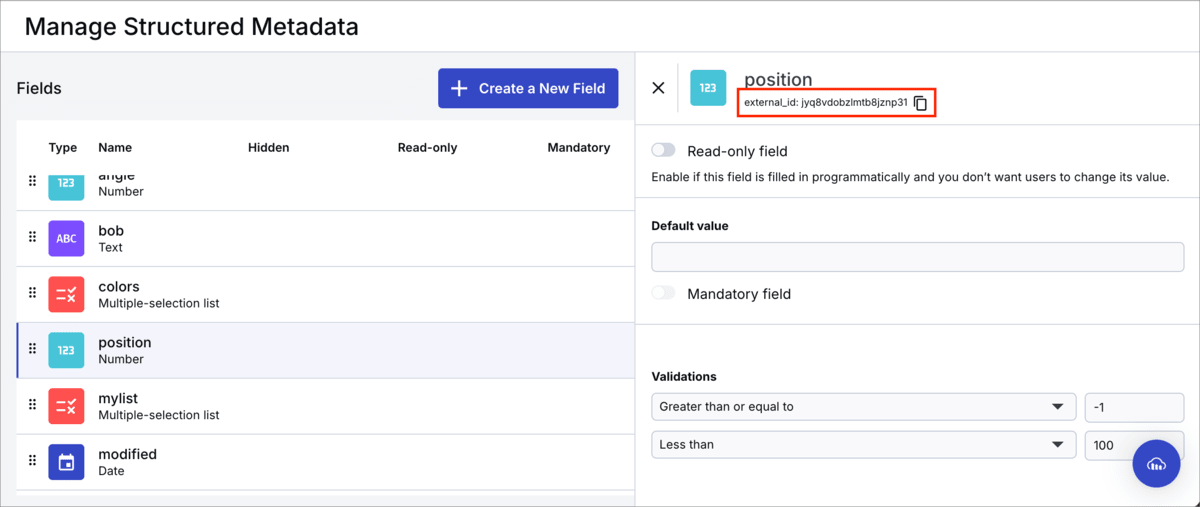
Example use case
Retrieve asset licensing details stored in structured metadata.
Get Tags
Retrieves the tags assigned to an asset.
Configuration
| Field | Type | Required | Description |
|---|---|---|---|
| Use the asset from | Asset selector | Yes* | Choose the asset using the mode menu beside the field: Dynamic Asset to use an asset from a previous block, Static Asset to pick a fixed asset from your Media Library, or Advanced / Custom to specify the asset details yourself below. |
| Public ID | Text | Yes* | The asset public ID. Required when Custom is selected. |
| Delivery type | Text | Yes* | The delivery type for the asset (e.g., upload, private, authenticated). Required when Custom is selected. |
| Resource type | Text | Yes* | The asset type (image, video, raw). Required when Custom is selected. |
Example use case
Check if an asset has a specific tag before processing it.
Move To Folder
Moves an asset to a different folder.
Configuration
| Field | Type | Required | Description |
|---|---|---|---|
| Use the asset from | Asset selector | Yes* | Choose the asset using the mode menu beside the field: Dynamic Asset to use an asset from a previous block, Static Asset to pick a fixed asset from your Media Library, or Advanced / Custom to specify the asset details yourself below. |
| Public ID | Text | Yes* | The asset public ID. Required when Custom is selected. |
| Delivery type | Text | Yes* | The delivery type for the asset (e.g., upload, private, authenticated). Required when Custom is selected. |
| Resource type | Text | Yes* | The asset type (image, video, raw). Required when Custom is selected. |
| Target folder | Folder selector | Yes | The folder where you want to move the asset to. The field will not switch to Fixed mode if the folder does not exist in your Cloudinary account. |
Example use case
Move approved images to a specific folder.
Prepare Or Update Asset
Prepares eager transformations or performs updates on a Cloudinary asset. Supply a transformation to generate derived assets ahead of delivery, and use Optional parameters for any other update the API supports.
Configuration
| Field | Type | Required | Description |
|---|---|---|---|
| Use the asset from | Asset selector | Yes* | Choose the asset using the mode menu beside the field: Dynamic Asset to use an asset from a previous block, Static Asset to pick a fixed asset from your Media Library, or Advanced / Custom to specify the asset details yourself below. |
| Public ID | Text | Yes* | The asset public ID. Required when Custom is selected. |
| Delivery type | Text | Yes* | The delivery type for the asset (e.g., upload, private, authenticated). Required when Custom is selected. |
| Resource type | Text | Yes* | The asset type (image, video, raw). Required when Custom is selected. |
| Eager transformation | Text | No | The transformation to eagerly generate for the asset (in URL syntax). |
| Explicit parameters | Code | No | The optional parameters of the Explicit API method, in JSON format. You can use JSONLint.com to validate your JSON. |
(e.g.,
"text": "\\{\\{DATE(2017-02-14T06:08:39Z,SHORT)\\}\\}").Example use case
Convert an uploaded video to multiple formats before publishing.
Example optional parameters
Apply tags to the asset, update the contextual metadata and request quality analysis on the asset.
Relate Assets
Relates (or links) two Cloudinary assets, so that they are associated with each other in the Media Library.
Configuration
| Field | Type | Required | Description |
|---|---|---|---|
| Asset A: Select from block | Asset selector | Yes* | Choose the asset using the mode menu beside the field: Dynamic Asset to use an asset from a previous block, Static Asset to pick a fixed asset from your Media Library, or Advanced / Custom to specify the asset details yourself below. |
| Public ID (Asset A) | Text | Yes* | The public ID for Asset A. Required when Custom is selected. |
| Delivery type (Asset A) | Text | Yes* | The delivery type for Asset A (e.g., upload, private, authenticated). Required when Custom is selected. |
| Resource type (Asset A) | Text | Yes* | The asset type (image, video, raw). Required when Custom is selected. |
| Asset B: Select from block | Asset selector | Yes* | Choose the asset using the mode menu beside the field: Dynamic Asset to use an asset from a previous block, Static Asset to pick a fixed asset from your Media Library, or Advanced / Custom to specify the asset details yourself below. |
| Public ID (Asset B) | Text | Yes* | The public ID for Asset B. Required when Custom is selected. |
| Delivery type (Asset B) | Text | Yes* | The delivery type for Asset B (e.g., upload, private, authenticated). Required when Custom is selected. |
| Resource type (Asset B) | Text | Yes* | The asset type (image, video, raw). Required when Custom is selected. |
Example use case
Relate an image with a video showing the same product.
Rename Asset
Renames an asset (changes its public ID) or moves it to a different folder.
Configuration
| Field | Type | Required | Description |
|---|---|---|---|
| Select asset from block to rename | Asset selector | Yes* | Choose the asset using the mode menu beside the field: Dynamic Asset to use an asset from a previous block, Static Asset to pick a fixed asset from your Media Library, or Advanced / Custom to specify the asset details yourself below. |
| Current public ID | Text | Yes* | The asset public ID. Required when Custom is selected. |
| Delivery type | Text | Yes* | The delivery type for the asset (e.g., upload, private, authenticated). Required when Custom is selected. |
| Resource type | Text | Yes* | The asset type (image, video, raw). Required when Custom is selected. |
| New public ID | Text | Yes | The new public ID to assign to the asset. |
| Rename parameters | Code | No | The optional parameters of the Rename API method, in JSON format. You can use JSONLint.com to validate your JSON. Default: {}
|
(e.g.,
"text": "\\{\\{DATE(2017-02-14T06:08:39Z,SHORT)\\}\\}").Example use case
Standardize a file's public ID after upload, for example renaming IMG_4821 to spring-campaign/red-jacket-front.
Example optional parameters
Specify that a rename should overwrite existing assets with the same public ID, invalidate CDN cached copies of the asset together with all its transformed versions, and change the type to authenticated.
Search Assets
Finds assets based on search criteria. The block returns up to 50 results (set Max results to return fewer) in an array, which you can iterate over using the Repeat For Each Asset block.
Configuration
| Field | Type | Required | Description |
|---|---|---|---|
| Search expression | Text | Yes | The expression specifying the search query. See search expressions for syntax details. |
| Sort field | Dropdown | No | The field to sort the results by. Options: created_at, uploaded_at, public_id, filename, format, resource_type, type, bytes, width, height, aspect_ratio, pixels, duration, bit_rate, frame_ratefilename is the last segment of the public ID, without the folder path or file extension. |
| Sort order | Dropdown | No | Choose whether to sort results in ascending or descending order. Options: asc, desc
|
| Max results | Text | No | Maximum number of results to return (1–50). Example: 50
|
| Include structured metadata | Toggle | No | When enabled, the search results include each asset's structured metadata. |
Example use case
Find all assets that require syncing to a PIM.
Example search expressions
| Use case | Search expression |
|---|---|
| Find all assets in "products" with the tag "spring_collection" | folder=products AND tags=spring_collection |
| Find all assets that are of type "video" | resource_type=video |
Send For Manual Review
Sends an asset to manual moderation. You can later review it in the Console to approve or reject it.
Configuration
| Field | Type | Required | Description |
|---|---|---|---|
| Use the asset from | Asset selector | Yes* | Choose the asset using the mode menu beside the field: Dynamic Asset to use an asset from a previous block, Static Asset to pick a fixed asset from your Media Library, or Advanced / Custom to specify the asset details yourself below. |
| Public ID | Text | Yes* | The asset public ID. Required when Custom is selected. |
| Delivery type | Text | Yes* | The delivery type for the asset (e.g., upload, private, authenticated). Required when Custom is selected. |
| Resource type | Text | Yes* | The asset type (image, video, raw). Required when Custom is selected. |
Example use case
Manually review flagged images before you publish them.
Set Access Control
Controls access permissions for an asset. You can either make it publicly accessible, completely restricted, or set up access control based on the access_control parameter of the upload or update methods.
Configuration
| Field | Type | Required | Description |
|---|---|---|---|
| Use the asset from | Asset selector | Yes* | Choose the asset using the mode menu beside the field: Dynamic Asset to use an asset from a previous block, Static Asset to pick a fixed asset from your Media Library, or Advanced / Custom to specify the asset details yourself below. |
| Public ID | Text | Yes* | The asset public ID. Required when Custom is selected. |
| Delivery type | Text | Yes* | The delivery type for the asset (e.g., upload, private, authenticated). Required when Custom is selected. |
| Resource type | Text | Yes* | The asset type (image, video, raw). Required when Custom is selected. |
| Access control | Dropdown | Yes | Choose how to control access to this asset. Options: Restricted, Use Custom JSON (advanced), Public
|
| Custom JSON (advanced) | Code | No | Define detailed access control rules in JSON format. The provided JSON schema is an example, you may use it as a template. To use this field, select Use Custom JSON (advanced) in the Access Control field above; otherwise, it will be ignored. |
(e.g.,
"text": "\\{\\{DATE(2017-02-14T06:08:39Z,SHORT)\\}\\}").Example use case
Restrict access to confidential media assets.
Example custom JSON
Restrict an asset to require token based access except for the period from 15th December 2022 until 20th January 2024 when it will be publicly available:
Update Contextual Metadata
Adds, updates, or removes a contextual metadata key on an asset. Choose the action, then supply the key, and the value if you're adding or updating it.
Configuration
| Field | Type | Required | Description |
|---|---|---|---|
| Use the asset from | Asset selector | Yes* | Choose the asset using the mode menu beside the field: Dynamic Asset to use an asset from a previous block, Static Asset to pick a fixed asset from your Media Library, or Advanced / Custom to specify the asset details yourself below. |
| Public ID | Text | Yes* | The asset public ID. Required when Custom is selected. |
| Delivery type | Text | Yes* | The delivery type for the asset (e.g., upload, private, authenticated). Required when Custom is selected. |
| Resource type | Text | Yes* | The asset type (image, video, raw). Required when Custom is selected. |
| Metadata key | Text | Yes | The key of the metadata to add, update, or remove. |
| Metadata value | Text | Yes | The value to set for the key. Not relevant when removing metadata. |
| Action | Dropdown | No | Choose whether to add or update, or remove metadata on the asset. Options: Add or update, Remove
|
Example use case
Store a product's SKU as contextual metadata so later blocks can read it.
Update Structured Metadata
Updates structured metadata values for an asset. Select the field to update or clear, and supply the new value.
Configuration
| Field | Type | Required | Description |
|---|---|---|---|
| Use the asset from | Asset selector | Yes* | Choose the asset using the mode menu beside the field: Dynamic Asset to use an asset from a previous block, Static Asset to pick a fixed asset from your Media Library, or Advanced / Custom to specify the asset details yourself below. |
| Public ID | Text | Yes* | The asset public ID. Required when Custom is selected. |
| Delivery type | Text | Yes* | The delivery type for the asset (e.g., upload, private, authenticated). Required when Custom is selected. |
| Resource type | Text | Yes* | The asset type (image, video, raw). Required when Custom is selected. |
| Action | Dropdown | Yes | Choose whether to update or clear the structured metadata field. Options: Update, Clear
|
| Structured metadata field | Dropdown | Yes | Select the structured metadata field to update or clear. The dropdown lists the fields defined in your product environment. The block stores the field's external ID, so if you turn on Custom or insert the field as a variable, supply the external ID rather than the name. |
| Structured metadata value | Text, Number, Date, or Dropdown | Yes* | Enter the new value to assign to the metadata field. The input adapts to the type of the field you selected, so use a format that matches it. See Example metadata values. Required when Action is set to Update. |
The external ID is usually different from the field name. You can find it on the Manage Structured Metadata page when selecting a field.
Example use case
Store the expiry date of an image in structured metadata.
Example metadata values
The value you supply must match the type of the structured metadata field you selected. Text, number, and date fields are free-form, so you always enter the value directly. For selection lists you normally choose from a dropdown, and the formats in the table below apply when you enter the value manually or insert it as a variable.
| Metadata field type | Example value | Notes |
|---|---|---|
| Text | Spring 2026 campaign |
Any text string. |
| Number | 3 |
Whole numbers only. |
| Date | 2025-03-25 |
Use the format YYYY-MM-DD. |
| Single-selection list | ext_id_one |
The external ID of the list value, not the value shown in the dropdown. |
| Multiple-selection list | ["ext_id_one", "ext_id_two"] |
A JSON array of external IDs. |
Update Tags
Adds or removes tags from an asset. Choose the action, then supply the tag to add or remove.
Configuration
| Field | Type | Required | Description |
|---|---|---|---|
| Use the asset from | Asset selector | Yes* | Choose the asset using the mode menu beside the field: Dynamic Asset to use an asset from a previous block, Static Asset to pick a fixed asset from your Media Library, or Advanced / Custom to specify the asset details yourself below. |
| Public ID | Text | Yes* | The asset public ID. Required when Custom is selected. |
| Delivery type | Text | Yes* | The delivery type for the asset (e.g., upload, private, authenticated). Required when Custom is selected. |
| Resource type | Text | Yes* | The asset type (image, video, raw). Required when Custom is selected. |
| Action | Dropdown | No | Choose how to update tags: add new ones or remove existing ones. Options: Add, Remove
|
| Tag | Text | Yes | Enter one or more tags to apply or remove. Separate multiple tags with commas. |
Example use case
Tag assets for seasonal campaigns.
Update XMP Metadata
Updates XMP metadata embedded within an image asset. It merges the new XMP metadata with existing values, updating only the specified fields: any fields that already exist are overwritten, and fields that don't yet exist are added.
You can set any of the tags defined in the XMP specification using the tag name together with its qualifying namespace, e.g., "XMP-photoshop:Credit": "Company Photography Department".
Additionally, you can set any custom field using the XMP-cloudinary namespace, e.g., "XMP-cloudinary:TestCustomTextField": "TEST!".
Configuration
| Field | Type | Required | Description |
|---|---|---|---|
| Use the asset from | Asset selector | Yes* | Choose the asset using the mode menu beside the field: Dynamic Asset to use an asset from a previous block, Static Asset to pick a fixed asset from your Media Library, or Advanced / Custom to specify the asset details yourself below. |
| Public ID | Text | Yes* | The asset public ID. Required when Custom is selected. |
| Delivery type | Text | Yes* | The delivery type for the asset (e.g., upload, private, authenticated). Required when Custom is selected. |
| Resource type | Text | Yes* | The asset type (image, video, raw). Required when Custom is selected. |
| XMP metadata | Code | Yes | XMP metadata, using key-value pairs (JSON). Each key must be a tag name, optionally prefixed with its group, for example Keywords or XMP-dc:Title. Keys can't contain dots, and the block fails if any key isn't valid. |
(e.g.,
"text": "\\{\\{DATE(2017-02-14T06:08:39Z,SHORT)\\}\\}").Example use case
Add copyright and licensing information to product images by updating their XMP metadata fields.
Example XMP metadata
Update various pieces of information in an image:
You can view the XMP metadata in the Embedded metadata section of the asset management drill-down page:

Upload Asset From HTTP Response
Sends an HTTP request to a target URL, and then automatically uploads the file from the response to your Cloudinary product environment. Use this when the asset is only available behind a request that needs specific headers, a method, or a body.
Configuration
| Field | Type | Required | Description |
|---|---|---|---|
| Target URL | Text | Yes | The URL to send the request to. |
| Request method | Dropdown | No | The HTTP method to use for the request. Options: POST, GET, PUT
|
| Request headers | Code | No | The headers to send in the request, in JSON format. You can use JSONLint.com to validate your JSON. |
| Request message body | Code | No | The data to send in the request. |
(e.g.,
"text": "\\{\\{DATE(2017-02-14T06:08:39Z,SHORT)\\}\\}").Example use case
Retrieve and store images from a third-party API.
Upload Asset From URL
Uploads an asset from an FTP, HTTP, or HTTPS URL into your Cloudinary product environment.
This block calls the upload method of the Upload API. You can have full control over the optional upload parameters in the Upload parameters field.
Configuration
| Field | Type | Required | Description |
|---|---|---|---|
| Media URL | Text | Yes | The FTP, HTTP, or HTTPS URL of a file to upload. |
| Resource type | Dropdown | Yes | Specify the file type. Use Auto to detect automatically.Options: Auto, Video, Raw, Image
|
| Incoming transformation | Text | No | Apply a transformation to the media before it's saved. Use Cloudinary URL syntax. |
| Upload parameters | Code | No | Optional upload parameters of the Upload API method, in JSON format. You can use JSONLint.com to validate your JSON. |
(e.g.,
"text": "\\{\\{DATE(2017-02-14T06:08:39Z,SHORT)\\}\\}").Example use case
Automatically upload new images from an S3 bucket.
Example optional parameters
Apply tags and contextual metadata to the asset, and request quality analysis on the asset.
Media Analysis
Use these blocks to examine your media and return what they find, such as an answer to a question about an image, a moderation decision, or a set of quality indicators.
Analyze Image Quality
Analyzes the quality of an image and returns a comprehensive set of quality indicators, including JPEG quality, focus, noise, contrast, exposure, lighting, color score, resolution, and more.
Configuration
| Field | Type | Required | Description |
|---|---|---|---|
| Use the asset from | Asset selector | Yes* | Choose the asset using the mode menu beside the field: Dynamic Asset to use an asset from a previous block, Static Asset to pick a fixed asset from your Media Library, or Advanced / Custom to specify the asset details yourself below. |
| Public ID | Text | Yes* | The asset public ID. Required when Custom is selected. |
| Delivery type | Text | Yes* | The delivery type for the asset (e.g., upload, private, authenticated). Required when Custom is selected. |
| Resource type | Text | Yes* | The asset type (image, video, raw). Required when Custom is selected. |
Example use case
Check image focus quality before publishing product photos.
Learn more about Image quality analysis.
Ask AI About Image
Answers an open-ended question or instruction about an image with the Cloudinary AI Vision add-on.
Configuration
| Field | Type | Required | Description |
|---|---|---|---|
| Use the asset from | Asset selector | Yes* | Choose the asset using the mode menu beside the field: Dynamic Asset to use an asset from a previous block, Static Asset to pick a fixed asset from your Media Library, or Advanced / Custom to specify the asset details yourself below. |
| Public ID | Text | Yes* | The asset public ID. Required when Custom is selected. |
| Delivery type | Text | Yes* | The delivery type for the asset (e.g., upload, private, authenticated). Required when Custom is selected. |
| Resource type | Text | Yes* | The asset type (image, video, raw). Required when Custom is selected. |
| Prompt | Text | Yes | A question or a request to ask. Example: "Describe the image in detail". |
| Cloudinary AI Vision | Add-on subscription | Yes | Confirms the Cloudinary AI Vision add-on is registered for your product environment so this block can run. |
Example use case
Ask "What products are visible in this image?" and use the result to tag or categorize the asset.
Ask AI About Image Using Gemini
Analyzes an image using the Google Gemini API and answers an open-ended question about it. Choose the Gemini model to use and set the maximum number of tokens in the response.
Configuration
| Field | Type | Required | Description |
|---|---|---|---|
| Image URL | Text | Yes | The URL of the image to analyze. |
| Gemini connection | Connection | Yes | Select a Gemini connection to use for authentication. |
| Prompt | Text | Yes | Ask a question about the image, e.g., 'What is happening in this photo?' |
| Gemini model | Dropdown | Yes | The Gemini model to use for image analysis. Options: gemini-2.0-flash, gemini-2.5-flash-lite, gemini-2.5-flash, gemini-2.5-pro, gemini-3.1-pro-preview Default: gemini-3.1-pro-preview
|
| Max tokens | Number | No | Specify the maximum number of Gemini tokens allowed to be consumed (impacts the response length, costs, processing time, etc). Example: 300
|
| Enable thinking | Toggle | No | Allow the model to think more before generating the response (uses more tokens). Default: No
|
Example use case
Auto-generate alt text or summarize the visual content of an image using a prompt like "What is in this image?".
Ask AI About Image Using OpenAI
Analyzes an image using OpenAI's image understanding capabilities and answers an open-ended question about it. Set the image detail level and the maximum number of tokens in the response.
Configuration
| Field | Type | Required | Description |
|---|---|---|---|
| OpenAI connection | Connection | Yes | Select an OpenAI connection to use for authentication. |
| OpenAI project ID | Text | No | If you're using a legacy user API key or belong to multiple projects, you can optionally specify the project for API requests. |
| OpenAI organization ID | Text | No | If you belong to multiple organizations, you can optionally specify the organization for API requests. |
| Image URL | Text | Yes | The URL of the image to process. |
| Prompt | Text | Yes | Ask a question about the image, e.g., 'What is happening in this photo?' |
| Max tokens | Number | No | Specify the maximum number of OpenAI tokens allowed in the response (impacts the response length, costs, processing time, etc). Example: 300
|
| Image detail level | Dropdown | No | Set the level of image analysis detail: low, high, or auto. Use high for richer responses. Options: auto, high, low Default: auto
|
Example use case
Auto-generate alt text or summarize the visual content of an image using a prompt like "What is in this photo?".
Find Duplicate Images
Determines if duplicate images exist in your Media Library using the Cloudinary Duplicate Image Detection add-on.
Configuration
| Field | Type | Required | Description |
|---|---|---|---|
| Use the asset from | Asset selector | Yes* | Choose the asset using the mode menu beside the field: Dynamic Asset to use an asset from a previous block, Static Asset to pick a fixed asset from your Media Library, or Advanced / Custom to specify the asset details yourself below. |
| Public ID | Text | Yes* | The asset public ID. Required when Custom is selected. |
| Delivery type | Text | Yes* | The delivery type for the asset (e.g., upload, private, authenticated). Required when Custom is selected. |
| Resource type | Text | Yes* | The asset type (image, video, raw). Required when Custom is selected. |
| Threshold | Text | Yes | The minimum similarity score (0.0–1.0) for considering an image a duplicate. Higher values are stricter, e.g., 1.0 means completely identical whereas 0.8 means almost identical. |
| Wait for confidence result | Toggle | No | Whether to wait for the confidence score before continuing. Choose Yes if the result is needed for downstream logic. |
| Webhook URL | Text | No | Send a webhook when duplicate detection is complete. Use this to trigger another flow or external system. |
Example use case
Check if a similar image already exists in your Media Library before allowing it to be stored.
Moderate Image Using Amazon Rekognition
Moderates images for potentially sensitive content with the Amazon Rekognition AI Moderation add-on.
Configuration
| Field | Type | Required | Description |
|---|---|---|---|
| Use the asset from | Asset selector | Yes* | Choose the asset using the mode menu beside the field: Dynamic Asset to use an asset from a previous block, Static Asset to pick a fixed asset from your Media Library, or Advanced / Custom to specify the asset details yourself below. |
| Public ID | Text | Yes* | The asset public ID. Required when Custom is selected. |
| Delivery type | Text | Yes* | The delivery type for the asset (e.g., upload, private, authenticated). Required when Custom is selected. |
| Resource type | Text | Yes* | The asset type (image, video, raw). Required when Custom is selected. |
| Moderation confidence level | Text | Yes | Set the minimum confidence level (0.0–1.0) required for a category to be flagged. Lower values are more sensitive. |
| Moderation categories | Multi-select | No | Select one or more content categories to moderate. Options: alcohol, explicit_nudity, drugs, rude_gestures, hate_symbols, gambling, visually_disturbing, tobacco, suggestive_nudity, violence
|
| Rekognition AI Moderation | Add-on subscription | Yes | Confirms the Amazon Rekognition AI Moderation add-on is registered for your product environment so this block can run. |
Example use case
Flag images with explicit or inappropriate content to prevent publishing.
Moderate Image Using Custom Rules
Asks up to ten yes/no questions about an image and gets structured moderation responses with the Cloudinary AI Vision add-on.
Configuration
| Field | Type | Required | Description |
|---|---|---|---|
| Use the asset from | Asset selector | Yes* | Choose the asset using the mode menu beside the field: Dynamic Asset to use an asset from a previous block, Static Asset to pick a fixed asset from your Media Library, or Advanced / Custom to specify the asset details yourself below. |
| Public ID | Text | Yes* | The asset public ID. Required when Custom is selected. |
| Delivery type | Text | Yes* | The delivery type for the asset (e.g., upload, private, authenticated). Required when Custom is selected. |
| Resource type | Text | Yes* | The asset type (image, video, raw). Required when Custom is selected. |
| Rejection questions (prompts) | Multi-value text | Yes | A list of rejection questions to ask (max 10). Example: "Does the image contain alcohol?". |
| Cloudinary AI Vision | Add-on subscription | Yes | Confirms the Cloudinary AI Vision add-on is registered for your product environment so this block can run. |
Example use case
Automatically flag images that include restricted content.
AI Media Enrichment
Use these blocks to generate metadata for your assets with AI, such as tags, captions, and alt text.
Generate Alt Text
Generates SEO-friendly alt text for an image using Cloudinary AI Vision, and saves it to the asset's contextual metadata in the selected language(s).
This block consolidates what would typically require multiple separate blocks, namely analyzing the image with AI Vision, processing the results, translating the alt text into multiple languages, and updating contextual metadata, into a single streamlined action. This makes it easier to add accessible, SEO-optimized descriptions to your assets at scale across multiple languages.
The generated alt text is concise (typically one sentence, up to 125 characters), objective, and accurate. It avoids marketing language and unnecessary detail, prioritizes clarity for screen-reader users, and naturally incorporates SEO keywords when relevant. You can customize this behavior by providing Additional instructions to modify the prompt.
Configuration
| Field | Type | Required | Description |
|---|---|---|---|
| Use the asset from | Asset selector | Yes* | Choose the asset using the mode menu beside the field: Dynamic Asset to use an asset from a previous block, Static Asset to pick a fixed asset from your Media Library, or Advanced / Custom to specify the asset details yourself below. |
| Public ID | Text | Yes* | The asset public ID. Required when Custom is selected. |
| Delivery type | Text | Yes* | The delivery type for the asset (e.g., upload, private, authenticated). Required when Custom is selected. |
| Resource type | Text | Yes* | The asset type (image, video, raw). Required when Custom is selected. |
| Output language(s) | Multi-select | Yes | Output language(s) for stored alt text. Select one or more languages. Options: Acehnese (ace), Afar (aa), Afrikaans (af), Arabic (ar), Armenian (hy), Assamese (as), Avar (av), Aymara (ay), Bambara (bm), Bashkir (ba), Basque (eu), Belarusian (be), Bemba (bem), Bengali (bn), Bhojpuri (bho), Breton (br), Burmese (my), Catalan (ca), Cebuano (ceb), Chamorro (ch), Chechen (ce), Chichewa (ny), Chinese (zh), Chuvash (cv), Corsican (co), Czech (cs), Danish (da), Dhivehi (dv), Dutch (nl), Dzongkha (dz), English (en), Esperanto (eo), Ewe (ee), Faroese (fo), Fijian (fj), Finnish (fi), French (fr), Frisian (fy), Fulani (ff), Ga (gaa), Galician (gl), Georgian (ka), German (de), Greek (el), Guarani (gn), Gujarati (gu), Haitian Creole (ht), Hausa (ha), Hebrew (he), Hiligaynon (hil), Hindi (hi), Hungarian (hu), Igbo (ig), Ilocano (ilo), Italian (it), Japanese (ja), Javanese (jw), Kalaallisut (kl), Kannada (kn), Kanuri (kr), Kapampangan (pam), Kazakh (kk), Khmer (km), Kikongo (kg), Kinyarwanda (rw), Komi (kv), Korean (ko), Kurdish (Kurmanji) (ku), Kyrgyz (ky), Lao (lo), Latin (la), Limburgish (li), Lingala (ln), Lithuanian (lt), Luganda (lg), Luxembourgish (lb), Macedonian (mk), Madurese (mad), Malagasy (mg), Malay (Jawi) (ms-Arab), Malayalam (ml), Manx (gv), Marathi (mr), Marshallese (mh), Meiteilon (Manipuri) (mni-Mtei), Ndebele (South) (nr), Occitan (oc), Odia (Oriya) (or), Oromo (om), Ossetian (os), Polish (pl), Portuguese (pt), Punjabi (pa), Punjabi (Shahmukhi) (pa-Arab), Quechua (qu), Romanian (ro), Rundi (rn), Russian (ru), Sami (North) (se), Samoan (sm), Sango (sg), Sanskrit (sa), Santali (sat), Scots Gaelic (gd), Sesotho (st), Shan (shn), Shona (sn), Sindhi (sd), Sinhala (si), Slovenian (sl), Somali (so), Spanish (es), Swati (ss), Tahitian (ty), Tajik (tg), Tamazight (tzm), Tamazight (Tifinagh) (zgh), Tamil (ta), Tatar (tt), Telugu (te), Thai (th), Tibetan (bo), Tigrinya (ti), Tiv (tiv), Tok Pisin (tpi), Tongan (to), Tsonga (ts), Tswana (tn), Turkish (tr), Turkmen (tk), Twi (ak), Ukrainian (uk), Urdu (ur), Uyghur (ug), Venda (ve), Venetian (vec), Vietnamese (vi), Waray (war), Wolof (wo), Zulu (zu)
|
| SEO keywords | Text | No | Optional comma-separated keywords to include in the generated alt text. |
| Focus guidance | Text | No | Optional guidance for what the alt text should emphasize (e.g., product focus). |
| Additional instructions | Code | No | Optional additional instructions to override the default alt text generation instructions. If provided, this will replace the default prompt entirely. |
| Cloudinary AI Vision | Add-on subscription | Yes | Confirms the Cloudinary AI Vision add-on is registered for your product environment so this block can run. |
Example use case
Automatically generate accessible alt text for product images across multiple languages to improve SEO and accessibility.
Generate Image Caption
Generates a descriptive caption for an image using the Cloudinary AI Content Analysis add-on.
Configuration
| Field | Type | Required | Description |
|---|---|---|---|
| Use the asset from | Asset selector | Yes* | Choose the asset using the mode menu beside the field: Dynamic Asset to use an asset from a previous block, Static Asset to pick a fixed asset from your Media Library, or Advanced / Custom to specify the asset details yourself below. |
| Public ID | Text | Yes* | The asset public ID. Required when Custom is selected. |
| Delivery type | Text | Yes* | The delivery type for the asset (e.g., upload, private, authenticated). Required when Custom is selected. |
| Resource type | Text | Yes* | The asset type (image, video, raw). Required when Custom is selected. |
| Cloudinary AI Content Analysis | Add-on subscription | Yes | Confirms the Cloudinary AI Content Analysis add-on is registered for your product environment so this block can run. |
Example use case
Create SEO-friendly alt text for product photos.
Tag Image Using AI Analysis
Analyzes and tags an image using the Cloudinary AI Content Analysis add-on. See the model documentation for details on the capabilities and strengths of each model.
Configuration
| Field | Type | Required | Description |
|---|---|---|---|
| Use the asset from | Asset selector | Yes* | Choose the asset using the mode menu beside the field: Dynamic Asset to use an asset from a previous block, Static Asset to pick a fixed asset from your Media Library, or Advanced / Custom to specify the asset details yourself below. |
| Public ID | Text | Yes* | The asset public ID. Required when Custom is selected. |
| Delivery type | Text | Yes* | The delivery type for the asset (e.g., upload, private, authenticated). Required when Custom is selected. |
| Resource type | Text | Yes* | The asset type (image, video, raw). Required when Custom is selected. |
| Detection model | Dropdown | Yes | Choose the AI tagging model to use. Options: human-anatomy, cld-fashion, unidet, cld-text, coco, lvis, shop-classifier, watermark-detection, iqa, image-type
|
| Confidence score | Text | Yes | Set the minimum confidence level (0.0–1.0) required for a tag to be applied to the image. Fewer tags are applied as the confidence level increases. Example: 0.9
|
| Cloudinary AI Content Analysis | Add-on subscription | Yes | Confirms the Cloudinary AI Content Analysis add-on is registered for your product environment so this block can run. |
Example use case
Auto-tag product images based on visual content.
Tag Image Using Custom Rules
Generates tags from yes/no prompts and optionally applies the tags to the image with the Cloudinary AI Vision add-on.
Configuration
| Field | Type | Required | Description |
|---|---|---|---|
| Use the asset from | Asset selector | Yes* | Choose the asset using the mode menu beside the field: Dynamic Asset to use an asset from a previous block, Static Asset to pick a fixed asset from your Media Library, or Advanced / Custom to specify the asset details yourself below. |
| Public ID | Text | Yes* | The asset public ID. Required when Custom is selected. |
| Delivery type | Text | Yes* | The delivery type for the asset (e.g., upload, private, authenticated). Required when Custom is selected. |
| Resource type | Text | Yes* | The asset type (image, video, raw). Required when Custom is selected. |
| Tag definitions (prompts) | Multi-value text | Yes | Define up to 10 tag definitions. Tag names can contain only lowercase letters and dashes. A tag is returned and optionally applied when its rule returns true. For example: apply the tag "desk" if the answer to "Does the image contain a desk?" is yes. |
| Add tags to asset | Toggle | No | Whether to automatically apply the matching tags to the asset. |
| Cloudinary AI Vision | Add-on subscription | Yes | Confirms the Cloudinary AI Vision add-on is registered for your product environment so this block can run. |
Example use case
Tag all images containing people by defining a tag definition like:
Tag: "person"
Rule: "Does this image contain a person?"
Tag Image Using Google AI
Adds tags to an image using the Google Auto Tagging add-on.
Configuration
| Field | Type | Required | Description |
|---|---|---|---|
| Use the asset from | Asset selector | Yes* | Choose the asset using the mode menu beside the field: Dynamic Asset to use an asset from a previous block, Static Asset to pick a fixed asset from your Media Library, or Advanced / Custom to specify the asset details yourself below. |
| Public ID | Text | Yes* | The asset public ID. Required when Custom is selected. |
| Delivery type | Text | Yes* | The delivery type for the asset (e.g., upload, private, authenticated). Required when Custom is selected. |
| Resource type | Text | Yes* | The asset type (image, video, raw). Required when Custom is selected. |
| Confidence level | Text | Yes | Set the minimum confidence level (0.0–1.0) required for a tag to be applied to the image. Fewer tags are applied as the confidence level increases. |
| Google Auto Tagging | Add-on subscription | Yes | Confirms the Google Auto Tagging add-on is registered for your product environment so this block can run. |
Example use case
Automatically tag lifestyle photos in your Media Library for easier search.
Tag Video Using Google AI
Adds tags to a video using the Google Automatic Video Tagging add-on.
Configuration
| Field | Type | Required | Description |
|---|---|---|---|
| Use the asset from | Asset selector | Yes* | Choose the asset using the mode menu beside the field: Dynamic Asset to use an asset from a previous block, Static Asset to pick a fixed asset from your Media Library, or Advanced / Custom to specify the asset details yourself below. |
| Public ID | Text | Yes* | The asset public ID. Required when Custom is selected. |
| Delivery type | Text | Yes* | The delivery type for the asset (e.g., upload, private, authenticated). Required when Custom is selected. |
| Resource type | Text | Yes* | The asset type (image, video, raw). Required when Custom is selected. |
| Confidence level | Text | Yes | Set the minimum confidence level (0.0–1.0) required for a tag to be applied to the video. Fewer tags are applied as the confidence level increases. |
| Google Automatic Video Tagging | Add-on subscription | Yes | Confirms the Google Automatic Video Tagging add-on is registered for your product environment so this block can run. |
| Webhook URL | Text | No | Enter a URL to receive a webhook notification when processing completes. You can use this to trigger another flow in MediaFlows or notify an external system. |
Example use case
Enrich marketing videos with searchable tags like "beach" or "running".
Media Generation
Use these blocks to create a new asset, either from a text prompt or from an existing asset.
Generate Image From Reference Image
Generates an image from a text prompt, guided by a reference asset, using the Cloudinary Image Generation add-on. The add-on provides a unified API backed by multiple AI model families, such as Nano Banana, Flux, and GPT Image.
The generated image is stored in your Cloudinary product environment, ready for delivery, transformation, and optimization.
Configuration
| Field | Type | Required | Description |
|---|---|---|---|
| Use the asset from | Asset selector | Yes* | Choose the asset using the mode menu beside the field: Dynamic Asset to use an asset from a previous block, Static Asset to pick a fixed asset from your Media Library, or Advanced / Custom to specify the asset details yourself below. |
| Reference asset public ID | Text | Yes* | The public ID of the asset to guide the generated image. Required when Custom is selected. |
| Resource type | Text | Yes* | The reference asset type (image, video, raw). Required when Custom is selected. |
| Delivery type | Text | Yes* | The reference asset's delivery type (e.g., upload, private, authenticated). Required when Custom is selected. |
| Prompt | Text area | Yes | Describe the image you want to create from the reference. |
| Model | Dropdown | Yes | Choose which AI model creates your image. Each model has its own visual style. Options: Nano Banana (default), Flux, GPT Image, RecraftGenerating from a reference asset requires an edit-capable model. Ideogram appears in the list but isn't edit-capable, so don't select it for this block. |
| Aspect ratio | Dropdown | Yes | Shape of the generated image. Keep Same as reference image to match the reference's shape, or pick a specific ratio. Options: Same as reference image (default), Landscape (16:9), Square (1:1), Portrait (9:16), Standard (4:3), Classic (3:2)
|
| Quality | Dropdown | Yes | Premium uses higher-fidelity models. Standard is faster and uses fewer credits. Available under Advanced Settings. Options: Premium (default), Standard
|
| Resolution | Dropdown | No | Higher resolution produces more detail. Ignored when Aspect ratio is Same as reference image. Available under Advanced Settings. Options: Standard (1K) (default), High (2K)
|
| Link to reference asset | Toggle | No | Relate the generated image to the reference asset in Cloudinary, so each can be found from the other. Available under Advanced Settings. |
| Cloudinary Image Generation | Add-on subscription | Yes | Shows the status of the Cloudinary Image Generation add-on for your product environment. If you're not yet registered, the free plan is enabled the first time the block runs. |
Example use case
Create seasonal variations of a product photo, keeping the original product as the reference so the generated images stay on-brand.
Generate Image From Text
Generates an image from a text prompt using the Cloudinary Image Generation add-on. The add-on provides a unified API backed by multiple AI model families, such as Nano Banana, Flux, and GPT Image.
The generated image is stored in your Cloudinary product environment, ready for delivery, transformation, and optimization.
Configuration
| Field | Type | Required | Description |
|---|---|---|---|
| Prompt | Text area | Yes | Describe the image you want to create. For example: A cat wearing a top hat, studio lighting. |
| Model | Dropdown | Yes | Choose which AI model creates your image. Each model has its own visual style. Options: Nano Banana (default), Flux, GPT Image, Ideogram, Recraft
|
| Aspect ratio | Dropdown | Yes | Choose the shape of the generated image. Options: Landscape (16:9) (default), Square (1:1), Portrait (9:16), Standard (4:3), Classic (3:2)
|
| Quality | Dropdown | Yes | Premium uses higher-fidelity models. Standard is faster and uses fewer credits. Available under Advanced Settings. Options: Premium (default), Standard
|
| Resolution | Dropdown | Yes | Higher resolution produces more detail. Available under Advanced Settings. Options: Standard (1K) (default), High (2K)
|
| Cloudinary Image Generation | Add-on subscription | Yes | Shows the status of the Cloudinary Image Generation add-on for your product environment. If you're not yet registered, the free plan is enabled the first time the block runs. |
Example use case
Generate on-brand background images for a marketing campaign from a text description, without a photoshoot.
Generate Image Using Gemini
Generates an image using the Google Gemini image generation API from a prompt you supply, and automatically uploads the result to your Cloudinary product environment. Optionally supply a source image to guide the generation.
Configuration
| Field | Type | Required | Description |
|---|---|---|---|
| Gemini connection | Connection | Yes | Select a Gemini connection to use for authentication. |
| Prompt | Text | Yes | A text description of the desired image that should be generated. |
| Gemini model | Dropdown | Yes | The Gemini model to use for image generation. Options: gemini-3-pro-image, gemini-3.1-flash-image, gemini-2.5-flash-image Default: gemini-3-pro-image
|
| Image URL | Text | No | The image URL that should be included with the prompt - either for the image to be edited or as input for a new image generation. |
| Upload parameters | Code | No | Optional upload parameters of the Upload API method, in JSON format. See the Upload API reference for a full list of possible parameters. You can use JSONLint.com to validate your JSON. Default: {}
|
(e.g.,
"text": "\\{\\{DATE(2017-02-14T06:08:39Z,SHORT)\\}\\}").Example use case
Automatically generate product variations or marketing visuals based on existing product images and text descriptions, then store them in Cloudinary for further processing or delivery.
Generate Image Using OpenAI
Generates an image using the OpenAI image generation API from a prompt you supply, and automatically uploads the result to your Cloudinary product environment.
Configuration
| Field | Type | Required | Description |
|---|---|---|---|
| OpenAI connection | Connection | Yes | Select an OpenAI connection to use for authentication. |
| OpenAI model | Dropdown | Yes | The OpenAI model to use for image generation. Options: gpt-image-1, dall-e-3, dall-e-2
|
| OpenAI organization ID | Text | No | If you belong to multiple organizations, you can optionally specify the organization for API requests. |
| OpenAI project ID | Text | No | If you're using a legacy user API key or belong to multiple projects, you can optionally specify the project for API requests. |
| Prompt | Text | Yes | A text description of the desired image(s) that should be generated. |
| Create image parameters | Code | No | Optional OpenAI 'create image' parameters, in JSON format. See the OpenAI API reference for a full list of possible parameters. You can use JSONLint.com to validate your JSON. Default: {}
|
| Upload parameters | Code | No | Optional upload parameters of the Upload API method, in JSON format. See the Upload API reference for a full list of possible parameters. You can use JSONLint.com to validate your JSON. Default: {}
|
(e.g.,
"text": "\\{\\{DATE(2017-02-14T06:08:39Z,SHORT)\\}\\}").Example use case
Automatically generate placeholder images or marketing visuals based on product descriptions, then store them in Cloudinary for further processing or delivery.
Generate Video From Image
Generates a short video clip from a Cloudinary image using AI.
Set the duration, aspect ratio, and resolution, choose whether to add audio, and optionally supply a prompt to guide the result.
Configuration
| Field | Type | Required | Description |
|---|---|---|---|
| Use the asset from | Asset selector | Yes* | Choose the asset using the mode menu beside the field: Dynamic Asset to use an asset from a previous block, Static Asset to pick a fixed asset from your Media Library, or Advanced / Custom to specify the asset details yourself below. |
| Public ID | Text | Yes* | The public ID of the source image asset. Required when Custom is selected. |
| Delivery type | Text | Yes* | The delivery type of the source image (e.g., upload, private, authenticated). Required when Custom is selected. |
| Resource type | Text | Yes* | The asset type (must be image). Required when Custom is selected. |
| Animation prompt | Text area | Yes | A text description guiding the animation, for example, Make the person wave. |
| Duration | Dropdown | No | Length of the generated video, in seconds. 1080p resolution requires 8 seconds. Options: 4 seconds, 6 seconds, 8 seconds Default: 8 seconds
|
| Resolution | Dropdown | No | Output video resolution. 1080p is only available with a duration of 8 seconds. Options: 720p, 1080p Default: 720p
|
| Aspect ratio | Dropdown | No | Output video aspect ratio. Auto follows the source image.Options: 16:9, 9:16, Auto Default: Auto
|
| Generate audio | Toggle | No | Whether to include AI-generated audio in the output video. Default: off. |
| Enhance prompt | Toggle | No | Let Cloudinary expand your prompt with extra detail before generating the video. Default: on. |
Example use case
Automatically turn product photos into short promotional video clips for social media, without manual video editing.
Generate Virtual Photoshoot Using Fal AI
Generates virtual photoshoot images from an existing person image using fal.ai.
Select a person image from a previous block, or click Custom to specify the asset directly. Describe the desired photoshoot using seven structured fields: short description, pose, facial expression, clothes, scene, lighting, and camera positioning. The block composes these fields into a prompt and sends it with the person image to your selected fal.ai model (Gemini 3 Pro or GPT Image 1.5). The generated image is automatically uploaded to Cloudinary and can optionally be related to the original person asset.
The block outputs the uploaded asset's public_id, secure_url, type, and resource_type for use by downstream blocks.
Configuration
| Field | Type | Required | Description |
|---|---|---|---|
| Use person image from | Asset selector | Yes* | Choose the asset using the mode menu beside the field: Dynamic Asset to use an asset from a previous block, Static Asset to pick a fixed asset from your Media Library, or Advanced / Custom to specify the asset details yourself below. |
| Person public ID | Text | Yes* | The person image public ID. Required when Custom is selected. |
| Person delivery type | Text | Yes* | The delivery type for the person asset (e.g., upload, private, authenticated). Required when Custom is selected. |
| Person resource type | Text | Yes* | The asset type for the person image (typically image). Required when Custom is selected. |
| Fal AI connection | Connection | Yes | Select a Fal AI connection to use for authentication. |
| Model | Dropdown | Yes | Which fal.ai model to use for the virtual photoshoot. Options: GPT Image 1.5, Gemini 3 Pro Default: GPT Image 1.5
|
| Short description | Text | Yes | Brief description of the desired photoshoot result. Example: Pose the model in front of a building
|
| Pose | Text | No | How the model should be posed. Leave empty to try to preserve the original pose. Example: Full-body photoshoot, hands in pockets
|
| Facial expression | Text | No | Desired facial expression and head orientation. Leave empty to try to preserve the original expression. Example: Face slightly turned to the right
|
| Clothes | Text | No | What the model should be wearing. Leave empty to try to preserve the original clothing. Example: The model is wearing a suit
|
| Scene | Text | No | Scene, background, and framing. Leave empty to try to preserve the original scene. Example: Full body shot, standing in front of a building
|
| Lighting | Text | No | Lighting style for the scene. Leave empty to try to preserve the original lighting. Example: Natural, according to the scene
|
| Camera positioning | Text | No | Camera angle, height, and position. Leave empty to try to preserve the original camera angle. Example: Slightly above ground, knee high, in front of the model
|
| Output format | Dropdown | Yes | Output image format. Options: PNG, JPG, WebP Default: PNG
|
| Destination folder | Folder selector | No | Cloudinary folder for the uploaded image. If empty, uploads to your home folder. |
| Asset name | Text | No | The public ID for the uploaded asset. The destination folder is prepended to it. If empty, uses the last part of the source image's public ID with a random 6-digit suffix. |
| Relate assets | Toggle | No | Relate the uploaded photoshoot image to the original person asset in Cloudinary. Default: Yes
|
Example use case
After a model photo is approved in Creative Approval, generate alternate poses and backgrounds for e-commerce galleries and save each result to a dedicated Cloudinary folder.
Generate Virtual Try On Using Fal AI
Generates virtual try-on images and adds them to your Cloudinary product environment using fal.ai.
Choose from four fal.ai models (FASHN v1.5, FASHN v1.6, Leffa Virtual TryOn, or Cat-VTON) and select the person and garment images from previous blocks, or click Custom to specify the assets directly. The block generates the try-on image via fal.ai, uploads it to Cloudinary as a new asset, and optionally links that asset to the person and garment assets so they appear related in Cloudinary.
The block outputs the uploaded asset's public_id, secure_url, type, and resource_type for use by downstream blocks.
Configuration
| Field | Type | Required | Description |
|---|---|---|---|
| Use garment image from | Asset selector | Yes* | Choose the asset using the mode menu beside the field: Dynamic Asset to use an asset from a previous block, Static Asset to pick a fixed asset from your Media Library, or Advanced / Custom to specify the asset details yourself below. |
| Garment public ID | Text | Yes* | The garment image public ID. Required when Custom is selected. |
| Garment delivery type | Text | Yes* | The delivery type for the garment asset (e.g., upload, private, authenticated). Required when Custom is selected. |
| Garment resource type | Text | Yes* | The asset type for the garment image (typically image). Required when Custom is selected. |
| Use person image from | Asset selector | Yes* | Choose the asset using the mode menu beside the field: Dynamic Asset to use an asset from a previous block, Static Asset to pick a fixed asset from your Media Library, or Advanced / Custom to specify the asset details yourself below. |
| Person public ID | Text | Yes* | The person image public ID. Required when Custom is selected. |
| Person delivery type | Text | Yes* | The delivery type for the person asset (e.g., upload, private, authenticated). Required when Custom is selected. |
| Person resource type | Text | Yes* | The asset type for the person image (typically image). Required when Custom is selected. |
| Fal AI connection | Connection | Yes | Select a Fal AI connection to use for authentication. |
| Model | Dropdown | Yes | Which fal.ai try-on model to use. Options: FASHN v1.6, FASHN v1.5, Leffa Virtual TryOn, Cat-VTON Default: FASHN v1.6
|
| Garment type | Dropdown | Yes | Type of garment. Options: Upper body, Lower body, Dress Default: Upper body
|
| Quality mode | Dropdown | Yes | Speed vs quality. Options: Performance, Balanced, Quality Default: Balanced
|
| Output format | Dropdown | Yes | Output image format. Only supported by FASHN and Leffa; Cat-VTON uses the model default. Options: PNG, JPG Default: PNG
|
| Destination folder | Folder selector | No | Cloudinary folder for the uploaded image. If empty, uploads to your home folder. |
| Asset name | Text | No | The public ID for the uploaded asset. The destination folder is prepended to it. If empty, combines the last parts of the person and garment public IDs, so running the block again for the same pair overwrites the previous image. |
| Relate assets | Toggle | Yes | Relate the uploaded try-on image to the person and garment assets so they appear connected in Cloudinary. Default: Yes
|
Example use case
Combine a flat-lay garment image with an on-model photo to produce try-on previews for PDPs, then upload the composite to Cloudinary and relate it to both source assets.
Media Editing
These blocks allow you to transform and enhance media in Cloudinary using actions like resize, overlay, effects, and generative AI.
Add Background Color Or Image
Adds a solid color or another image behind an image, filling any areas that are transparent. Choose the mode, then supply either a hex color code or the public ID of the background image. The new background is only visible where the original image is transparent, so run Remove Image Background first if the image still has one. This block modifies the original asset rather than creating a derived version.
Configuration
| Field | Type | Required | Description |
|---|---|---|---|
| Use the asset from | Asset selector | Yes* | Choose the asset using the mode menu beside the field: Dynamic Asset to use an asset from a previous block, Static Asset to pick a fixed asset from your Media Library, or Advanced / Custom to specify the asset details yourself below. |
| Public ID | Text | Yes* | The asset public ID. Required when Custom is selected. |
| Delivery type | Text | Yes* | The delivery type for the asset (e.g., upload, private, authenticated). Required when Custom is selected. |
| Resource type | Text | Yes* | The asset type (image, video, raw). Required when Custom is selected. |
| Mode | Dropdown | No | The type of background to apply, either a solid color or another image. Options: Hex color, Background image
|
| Parameter | Text | Yes | Enter the hex color code (e.g., FFFFFF) or the public ID (e.g., backgrounds/sample) of the background image, depending on the selected mode. Example: 4287F5
|
Example use case
Add a white background to a product cutout before displaying it on your storefront.
Add Drop Shadow
Adds realistic shadows to objects in an image using the dropshadow effect. Control the shadow with Azimuth for its direction, Elevation for the light angle, and Spread for how soft the edges are. This block modifies the original asset rather than creating a derived version.
Configuration
| Field | Type | Required | Description |
|---|---|---|---|
| Use the asset from | Asset selector | Yes* | Choose the asset using the mode menu beside the field: Dynamic Asset to use an asset from a previous block, Static Asset to pick a fixed asset from your Media Library, or Advanced / Custom to specify the asset details yourself below. |
| Public ID | Text | Yes* | The asset public ID. Required when Custom is selected. |
| Delivery type | Text | Yes* | The delivery type for the asset (e.g., upload, private, authenticated). Required when Custom is selected. |
| Resource type | Text | Yes* | The asset type (image, video, raw). Required when Custom is selected. |
| Azimuth | Text | Yes | The direction the light is coming from to cause the shadow effect. A value of 0 (north) means that the light is coming from behind the object and the shadow will be dropped towards the front of the object. Range: 0 to 360. Example: 215
|
| Elevation | Text | Yes | The height of the light source above the 'ground' to cause the shadow effect. Range: 0 to 90. Example: 45
|
| Spread | Text | Yes | The spread of the light source. A small number means 'point' light. A larger number means 'area' light. Range: 0 to 100. Example: 50
|
Example use case
Make isolated product images look more dimensional before publishing.
Add Image Overlay
Places another image over the main asset. Choose where the overlay sits using Placement, and fine-tune its position with the X and Y offsets. This block modifies the original asset rather than creating a derived version.
Configuration
| Field | Type | Required | Description |
|---|---|---|---|
| Use the asset from | Asset selector | Yes* | Choose the asset using the mode menu beside the field: Dynamic Asset to use an asset from a previous block, Static Asset to pick a fixed asset from your Media Library, or Advanced / Custom to specify the asset details yourself below. |
| Public ID | Text | Yes* | The asset public ID. Required when Custom is selected. |
| Delivery type | Text | Yes* | The delivery type for the asset (e.g., upload, private, authenticated). Required when Custom is selected. |
| Resource type | Text | Yes* | The asset type (image, video, raw). Required when Custom is selected. |
| Overlay URL | Text | Yes | The full URL of the image to overlay on the main asset. |
| Placement | Dropdown | No | The position where the overlay image will be placed on the main asset. Options: south_west, north_east, east, north_west, south, center, north, south_east, west
|
| X offset | Text | Yes | Horizontal offset relative to the placement anchor. It can be specified in pixels or as a percentage of the asset's width (e.g., 0.8 for 80%). |
| Y offset | Text | Yes | Vertical offset relative to the placement anchor. It can be specified in pixels or as a percentage of the asset's height (e.g., 0.8 for 80%). |
Example use case
Add a logo overlay to social media thumbnails.
Add Text Overlay
Adds styled text onto an image or video. Set the font, size, color, and style of the text, then position it using Placement with the X and Y offsets. This block modifies the original asset rather than creating a derived version.
Configuration
| Field | Type | Required | Description |
|---|---|---|---|
| Use the asset from | Asset selector | Yes* | Choose the asset using the mode menu beside the field: Dynamic Asset to use an asset from a previous block, Static Asset to pick a fixed asset from your Media Library, or Advanced / Custom to specify the asset details yourself below. |
| Public ID | Text | Yes* | The asset public ID. Required when Custom is selected. |
| Delivery type | Text | Yes* | The delivery type for the asset (e.g., upload, private, authenticated). Required when Custom is selected. |
| Resource type | Text | Yes* | The asset type (image, video, raw). Required when Custom is selected. |
| Text | Text | Yes | The text string to draw on the asset (you can use values from previous blocks). |
| Font | Dropdown | No | The font family to use for the text overlay. Options: georgia, open_sans, trebuchet_ms, helvetica, roboto, times_new_roman, montserrat, verdana, courier_new, arial
|
| Size | Text | Yes | The font size in pixels. |
| Style | Multi-select | No | Apply text styling effects. Select one or more styles to combine them. Options: underline, bold, italic
|
| Color | Text | Yes | Hex code for the text color (e.g., FF4500). |
| Placement | Dropdown | No | The anchor point where the text is positioned. Options: south_west, north_east, east, north_west, south, center, north, south_east, west
|
| X offset | Text | Yes | Horizontal offset relative to the placement anchor. It can be specified in pixels or as a percentage of the asset's width (e.g., 0.8 for 80%). Example: 0
|
| Y offset | Text | Yes | Vertical offset relative to the placement anchor. It can be specified in pixels or as a percentage of the asset's height (e.g., 0.8 for 80%). Example: 0
|
Example use case
Stamp an image with a dynamic label like "NEW" or "SALE".
Apply Custom Transformation
Applies a custom transformation to an asset, using either URL syntax or JSON format. This block modifies the original asset rather than creating a derived version.
Configuration
| Field | Type | Required | Description |
|---|---|---|---|
| Use the asset from | Asset selector | Yes* | Choose the asset using the mode menu beside the field: Dynamic Asset to use an asset from a previous block, Static Asset to pick a fixed asset from your Media Library, or Advanced / Custom to specify the asset details yourself below. |
| Public ID | Text | Yes* | The asset public ID. Required when Custom is selected. |
| Delivery type | Text | Yes* | The delivery type for the asset (e.g., upload, private, authenticated). Required when Custom is selected. |
| Resource type | Text | Yes* | The asset type (image, video, raw). Required when Custom is selected. |
| Transformation string | Text | No | A transformation in Cloudinary URL syntax, e.g., c_fill,w_400,h_400. |
| Transformation object | Code | Yes | A transformation in Cloudinary JSON syntax, using key-value pairs. Each parameter in the Transformation Reference shows this form in the SDK examples below it, for example c_fill is "crop": "fill". |
Example use case
Apply a rounded-corner crop with specific scaling and radius settings.
Either set the Transformation string to:
c_fill,g_face,h_200,w_200/r_max
Or set the Transformation object to:
Change Format And Quality
Changes an asset's format and quality. Set quality to automatic to let Cloudinary balance file size against visual quality. This block modifies the original asset rather than creating a derived version.
Configuration
| Field | Type | Required | Description |
|---|---|---|---|
| Use the asset from | Asset selector | Yes* | Choose the asset using the mode menu beside the field: Dynamic Asset to use an asset from a previous block, Static Asset to pick a fixed asset from your Media Library, or Advanced / Custom to specify the asset details yourself below. |
| Public ID | Text | Yes* | The asset public ID. Required when Custom is selected. |
| Delivery type | Text | Yes* | The delivery type for the asset (e.g., upload, private, authenticated). Required when Custom is selected. |
| Resource type | Text | Yes* | The asset type (image, video, raw). Required when Custom is selected. |
| Format | Dropdown | No | Select the output format for the media. Options: jpg, wdp, original, gif, heic, png, webp, jp2, webm, mp4, mov, m3u8, avif
|
| Quality | Dropdown | No | Specify the output quality. Use auto to let Cloudinary balance quality and file size. Options: 25, 50, 75, 90, auto, original
|
Example use case
Store optimized media to save on storage costs.
Crop Image Or Video
Crops an image or video to focus on a specific region. Set the width and height of the area to keep, and use Gravity to choose which part of the asset to keep in frame. This block modifies the original asset rather than creating a derived version.
Configuration
| Field | Type | Required | Description |
|---|---|---|---|
| Use the asset from | Asset selector | Yes* | Choose the asset using the mode menu beside the field: Dynamic Asset to use an asset from a previous block, Static Asset to pick a fixed asset from your Media Library, or Advanced / Custom to specify the asset details yourself below. |
| Public ID | Text | Yes* | The asset public ID. Required when Custom is selected. |
| Delivery type | Text | Yes* | The delivery type for the asset (e.g., upload, private, authenticated). Required when Custom is selected. |
| Resource type | Text | Yes* | The asset type (image, video, raw). Required when Custom is selected. |
| Width | Text | No | The width (in pixels) to crop the asset to. Leave blank to keep the original image width. |
| Height | Text | No | The height (in pixels) to crop the asset to. Leave blank to keep the original image height. |
| Gravity | Dropdown | No | Defines the focus point for cropping. Use auto for AI-based object detection or choose a fixed direction. Options: Auto, Center, South_West, South_East, West, South, North_West, North, East, North_East
|
Example use case
Crop a hero image to fit a banner layout on your website.
Extend Image Using Generative AI
Expands the dimensions of an image seamlessly with AI-generated pixels, using generative fill. Optionally specify a prompt to guide the result of the generation. This block modifies the original asset rather than creating a derived version.
Configuration
| Field | Type | Required | Description |
|---|---|---|---|
| Use the asset from | Asset selector | Yes* | Choose the asset using the mode menu beside the field: Dynamic Asset to use an asset from a previous block, Static Asset to pick a fixed asset from your Media Library, or Advanced / Custom to specify the asset details yourself below. |
| Public ID | Text | Yes* | The asset public ID. Required when Custom is selected. |
| Delivery type | Text | Yes* | The delivery type for the asset (e.g., upload, private, authenticated). Required when Custom is selected. |
| Resource type | Text | Yes* | The asset type (image, video, raw). Required when Custom is selected. |
| Gravity | Dropdown | No | Defines how the original image is positioned within the new extended canvas. Options: south_west, north_east, east, north_west, south, center, north, south_east, west
|
| Width | Text | Yes | The final width of the extended image. Use fixed values (e.g., 1200) or expressions like iw_mul_1.5 to scale relative to the original width. |
| Height | Text | Yes | The final height of the extended image. Use fixed values (e.g., 800) or expressions like ih_mul_2 to scale relative to the original height. |
| Prompt | Text | No | Optional prompt to guide the AI-generated fill area. |
Example use case
Extend the background of a product shot to fit a vertical ad layout.
Improve Image Brightness And Color
Improves the brightness, contrast, and colors of an image using the improve effect. This block modifies the original asset rather than creating a derived version.
Configuration
| Field | Type | Required | Description |
|---|---|---|---|
| Use the asset from | Asset selector | Yes* | Choose the asset using the mode menu beside the field: Dynamic Asset to use an asset from a previous block, Static Asset to pick a fixed asset from your Media Library, or Advanced / Custom to specify the asset details yourself below. |
| Public ID | Text | Yes* | The asset public ID. Required when Custom is selected. |
| Delivery type | Text | Yes* | The delivery type for the asset (e.g., upload, private, authenticated). Required when Custom is selected. |
| Resource type | Text | Yes* | The asset type (image, video, raw). Required when Custom is selected. |
| Scene | Dropdown | No | Select the type of scene to guide the improvement. Options: Outdoor, Indoor, Default
|
| Blend | Text | Yes | Set the intensity of the improvement (0–100). |
Example use case
Automatically improve user-uploaded photos before moderation.
Improve Media Quality Using Dolby
Improves the audio quality of a video or audio file using the Dolby.io Media Enhance API. You need a Dolby.io account to use this block.
Configuration
| Field | Type | Required | Description |
|---|---|---|---|
| Dolby connection | Connection | Yes | Select a Dolby connection to use for authentication. |
| Input | Text | Yes | The URL of the input audio or video file to enhance. Must be accessible by Dolby.io. |
| Output | Text | Yes | The destination URL where the processed file will be saved. Must point to a writable location. |
| Content | Dropdown | No | The type of media content. Used to optimize audio processing. Options: studio, voice_over, conference, music, mobile_phone, voice_recording, podcast, lecture, interview, meeting Default: interview
|
| Audio settings | Code | No | Optional advanced audio parameters in JSON format, such as noise reduction, speech leveling, or equalization. Example: { "noise": { "reduction": "medium" } } Default: {}
|
Example use case
Clean up low-quality user-generated videos before publishing them in your product gallery.
Recolor Object Using Generative AI
Recolors part of an image using generative recolor, while preserving shading and realism. Describe the object to recolor in the prompt, then set the target color. This block modifies the original asset rather than creating a derived version.
Configuration
| Field | Type | Required | Description |
|---|---|---|---|
| Use the asset from | Asset selector | Yes* | Choose the asset using the mode menu beside the field: Dynamic Asset to use an asset from a previous block, Static Asset to pick a fixed asset from your Media Library, or Advanced / Custom to specify the asset details yourself below. |
| Public ID | Text | Yes* | The asset public ID. Required when Custom is selected. |
| Delivery type | Text | Yes* | The delivery type for the asset (e.g., upload, private, authenticated). Required when Custom is selected. |
| Resource type | Text | Yes* | The asset type (image, video, raw). Required when Custom is selected. |
| Prompt | Text | Yes | Describe the object or area to recolor. |
| Target color | Text | Yes | The desired new color. You can use a named color (e.g., green or lightblue), or a 3 or 6 digit RGB hex color (e.g., F0A, FF4500). |
Example use case
Correct a product image whose color doesn't match the actual item.
Remove Image Background
Removes the background from an image using Cloudinary background removal. This block modifies the original asset rather than creating a derived version.
Configuration
| Field | Type | Required | Description |
|---|---|---|---|
| Use the asset from | Asset selector | Yes* | Choose the asset using the mode menu beside the field: Dynamic Asset to use an asset from a previous block, Static Asset to pick a fixed asset from your Media Library, or Advanced / Custom to specify the asset details yourself below. |
| Public ID | Text | Yes* | The asset public ID. Required when Custom is selected. |
| Delivery type | Text | Yes* | The delivery type for the asset (e.g., upload, private, authenticated). Required when Custom is selected. |
| Resource type | Text | Yes* | The asset type (image, video, raw). Required when Custom is selected. |
| Fine edges | Toggle | No | Enable improved edge detection for more accurate cutouts around hair, fur, or other soft details. |
| Foreground object | Multi-select | No | Optionally specify the main subject to focus on for background removal. Options: potted_plant, bus, motorbike, sofa, tv, bicycle, chair, dining_table, cow, bottle, boat, horse, car, person, airplane, cat, bird, dog, sheep, train
|
| Wait for confidence result | Toggle | No | Wait until the confidence score is available before continuing. Useful if you need to evaluate background removal quality in later steps. |
| Webhook URL | Text | No | Send a webhook notification when background removal is complete. Can be used to trigger another flow or system. |
Example use case
Automatically isolate products for marketplace listings.
Resize Image Or Video
Resizes an image or video by setting one dimension, either width or height, while keeping the original aspect ratio. This block modifies the original asset rather than creating a derived version.
Configuration
| Field | Type | Required | Description |
|---|---|---|---|
| Use the asset from | Asset selector | Yes* | Choose the asset using the mode menu beside the field: Dynamic Asset to use an asset from a previous block, Static Asset to pick a fixed asset from your Media Library, or Advanced / Custom to specify the asset details yourself below. |
| Public ID | Text | Yes* | The asset public ID. Required when Custom is selected. |
| Delivery type | Text | Yes* | The delivery type for the asset (e.g., upload, private, authenticated). Required when Custom is selected. |
| Resource type | Text | Yes* | The asset type (image, video, raw). Required when Custom is selected. |
| Dimension | Dropdown | No | Choose whether to resize by width or height. The other dimension will scale proportionally to maintain aspect ratio. Options: Height, Width
|
| Value | Text | Yes | Specify the new size using a fixed pixel value (e.g., 800) or a relative multiplier (e.g., 0.5 for 50% scale). |
Example use case
Scale down large images before uploading them to a partner system.
Video AI
These blocks provide video-specific functionality, interacting with the Cloudinary Video APIs.
Export Video Transcript
Exports a video's Cloudinary transcript as a subtitle file in SRT or WebVTT format, and uploads it as a new raw asset.
Configuration
| Field | Type | Required | Description |
|---|---|---|---|
| Use the asset from | Asset selector | Yes* | Choose the asset using the mode menu beside the field: Dynamic Asset to use an asset from a previous block, Static Asset to pick a fixed asset from your Media Library, or Advanced / Custom to specify the asset details yourself below. |
| Public ID | Text | Yes* | The asset public ID. Required when Custom is selected. |
| Delivery type | Text | Yes* | The delivery type for the asset (e.g., upload, private, authenticated). Required when Custom is selected. |
| Resource type | Text | Yes* | The asset type (image, video, raw). Required when Custom is selected. |
| Format | Dropdown | No | The subtitle file format to export. Options: SRT (.srt), WebVTT (.vtt) Default: SRT (.srt)
|
| Public ID suffix | Text | No | Text added to the end of the subtitle file's public ID. For example, my-video with the suffix _en produces my-video_en.srt. |
| Relate subtitle file to video | Toggle | No | Relate the generated subtitle file to the source video so they appear as related assets. Default: on. |
| Structured metadata | Array | No | Metadata to set on the subtitle file. Add one or more metadata field and value pairs using Add more. If your product environment has mandatory metadata fields, set them here, otherwise the upload fails. Grouped under Subtitle File Metadata in the sidebar. |
Example use case
Export transcriptions as .srt or .vtt files to use as subtitles in external video players or editing software.
Generate Video Chapters
Automatically generates chapter markers for a video, dividing it into meaningful segments with timestamps. Use the chapters to let viewers jump straight to the part of the video they need.
Configuration
| Field | Type | Required | Description |
|---|---|---|---|
| Use the asset from | Asset selector | Yes* | Choose the asset using the mode menu beside the field: Dynamic Asset to use an asset from a previous block, Static Asset to pick a fixed asset from your Media Library, or Advanced / Custom to specify the asset details yourself below. |
| Public ID | Text | Yes* | The asset public ID. Required when Custom is selected. |
| Delivery type | Text | Yes* | The delivery type for the asset (e.g., upload, private, authenticated). Required when Custom is selected. |
| Resource type | Text | Yes* | The asset type (image, video, raw). Required when Custom is selected. |
| Wait for completion | Toggle | No | Whether to wait for the chaptering result. Choose Yes if the result is needed for downstream logic. |
| Webhook URL | Text | No | Send a webhook when the chaptering process is complete. Use this to trigger another flow or external system. |
Example use case
Automatically create chapters for educational or webinar videos to improve viewer navigation.
Generate Video Details
Automatically generates and adds Video Title and Video Description contextual metadata to a video asset, and applies content-based tags.
AI generates the title, description, and tags from the video transcript, so the video must contain speech for this block to be effective. Cloudinary generates the transcript behind the scenes, so you don't need to generate one in advance.
- AI generates the title, description, and tags from the video transcript, therefore, for this block to be effective, the video must contain speech.
- Cloudinary generates the transcript 'behind the scenes', so there's no need to generate a transcript in advance.
Configuration
| Field | Type | Required | Description |
|---|---|---|---|
| Use the asset from | Asset selector | Yes* | Choose the asset using the mode menu beside the field: Dynamic Asset to use an asset from a previous block, Static Asset to pick a fixed asset from your Media Library, or Advanced / Custom to specify the asset details yourself below. |
| Public ID | Text | Yes* | The asset public ID. Required when Custom is selected. |
| Delivery type | Text | Yes* | The delivery type for the asset (e.g., upload, private, authenticated). Required when Custom is selected. |
| Resource type | Text | Yes* | The asset type (image, video, raw). Required when Custom is selected. |
| Wait for completion | Toggle | No | Whether to wait for processing to complete. Choose Yes if the result is needed for subsequent blocks. |
| Webhook URL | Text | No | Send a webhook when processing completes. Use this to trigger another flow or external system. |
Example use case
Automatically generate titles and descriptions that can be displayed by the Cloudinary Video Player, and tags to improve searchability and organization for user-uploaded videos.
Generate Video Transcript
Automatically generates a text transcript of the audio content in a video, using the Cloudinary video transcription capability. Select the languages to transcribe, and optionally relate the transcript to the source video.
Configuration
| Field | Type | Required | Description |
|---|---|---|---|
| Use the asset from | Asset selector | Yes* | Choose the asset using the mode menu beside the field: Dynamic Asset to use an asset from a previous block, Static Asset to pick a fixed asset from your Media Library, or Advanced / Custom to specify the asset details yourself below. |
| Public ID | Text | Yes* | The asset public ID. Required when Custom is selected. |
| Delivery type | Text | Yes* | The delivery type for the asset (e.g., upload, private, authenticated). Required when Custom is selected. |
| Resource type | Text | Yes* | The asset type (image, video, raw). Required when Custom is selected. |
| Translate to (languages) | Multi-select | No | One or more language codes for translation (e.g., en, es, fr).Options: Afrikaans (af), Albanian (sq), Amharic (am), Arabic (ar), Armenian (hy), Azerbaijani (az), Basque (eu), Belarusian (be), Bengali (bn), Bosnian (bs), Bulgarian (bg), Catalan (ca), Cebuano (ceb), Chichewa (ny), Chinese - Simplified (zh-CN), Chinese - Traditional (zh-TW), Corsican (co), Croatian (hr), Czech (cs), Danish (da), Dutch (nl), English (en), Esperanto (eo), Estonian (et), Filipino (tl), Finnish (fi), French (fr), Frisian (fy), Galician (gl), Georgian (ka), German (de), Greek (el), Gujarati (gu), Haitian Creole (ht), Hausa (ha), Hawaiian (haw), Hebrew (he), Hindi (hi), Hmong (hmn), Hungarian (hu), Icelandic (is), Igbo (ig), Indonesian (id), Irish (ga), Italian (it), Japanese (ja), Javanese (jv), Kannada (kn), Kazakh (kk), Khmer (km), Korean (ko), Kurdish - Kurmanji (ku), Kyrgyz (ky), Lao (lo), Latin (la), Latvian (lv), Lithuanian (lt), Luxembourgish (lb), Macedonian (mk), Malagasy (mg), Malay (ms), Malayalam (ml), Maltese (mt), Maori (mi), Marathi (mr), Mongolian (mn), Myanmar - Burmese (my), Nepali (ne), Norwegian (no), Pashto (ps), Persian (fa), Polish (pl), Portuguese (pt), Punjabi (pa), Romanian (ro), Russian (ru), Samoan (sm), Scots Gaelic (gd), Serbian (sr), Sesotho (st), Shona (sn), Sindhi (sd), Sinhala (si), Slovak (sk), Slovenian (sl), Somali (so), Spanish (es), Sundanese (su), Swahili (sw), Swedish (sv), Tajik (tg), Tamil (ta), Telugu (te), Thai (th), Turkish (tr), Ukrainian (uk), Urdu (ur), Uyghur (ug), Uzbek (uz), Vietnamese (vi), Welsh (cy), Xhosa (xh), Yiddish (yi), Yoruba (yo), Zulu (zu)
|
| Google Translate | Add-on subscription | Yes* | Confirms the Google Translation add-on is registered for your product environment so this block can run. Required when translation languages are selected. |
| Wait for completion | Toggle | No | Whether to wait for the transcription result. Choose Yes if the result is needed for downstream logic. |
| Relate transcripts to video | Toggle | No | Associate the generated .transcript files with the original video asset. *This will only work when "Wait for completion" is set to Yes. |
| Webhook URL | Text | No | Send a webhook when the transcription process is complete. Use this to trigger another flow or external system. |
Example use case
Generate transcripts for video content to improve accessibility and SEO.
Commerce
Use these blocks to keep the product media in your commerce platform in step with your Cloudinary assets.
Shopify
To use the Shopify blocks you need to create and install a custom app for your Shopify store. This allow access to the Shopify API.
Set up a custom app
Upload Image To Shopify
Uploads an image as raw bytes to a Shopify product using the Shopify GraphQL Admin API. Supply the image URL and product ID, and optionally wait for Shopify to finish processing the image before the flow continues.
Configuration
| Field | Type | Required | Description |
|---|---|---|---|
| Shopify connection | Connection | Yes | Select a Shopify connection to use for authentication. |
| Store name | Text | Yes | Your Shopify store name (the subdomain from your .myshopify.com URL, e.g., my-store). |
| Product ID | Text | Yes | The ID of the Shopify product to add the image to. |
| Image URL | Text | Yes | The URL of the image to upload to Shopify. |
| Alt text | Text | No | Alternative text description for the image (for accessibility). |
| Wait for upload to finish | Toggle | No | If enabled, the block polls Shopify until the media status is READY; otherwise, it returns immediately with the current status. Default: Yes
|
Example use case
Add AI-generated alt text and image to a Shopify product automatically after editing in Cloudinary.
Update Metafield In Shopify
Updates a metafield value for a Shopify product. Supply the metafield namespace, key, type, and the value to set.
Configuration
| Field | Type | Required | Description |
|---|---|---|---|
| Shopify connection | Connection | Yes | Select a Shopify connection to use for authentication. |
| Store name | Text | Yes | Your Shopify store name (the subdomain from your .myshopify.com URL, e.g., my-store). |
| Product ID | Text | Yes | The ID of the Shopify product to update. |
| Metafield key | Text | Yes | The key of the metafield to update. |
| Metafield value | Text | Yes | The value to set in the metafield. |
| Metafield namespace | Text | Yes | The namespace for the metafield. Example: custom
|
| Metafield type | Text | Yes | The type of the metafield value. Example: single_line_text_field
|
Example use case
Add the Cloudinary delivery URL of an optimized product image to a custom Shopify metafield.
Update Variant In Shopify
Updates the image of a Shopify product variant, or creates a new variant with an image. Identify the variant directly, or by up to three of its option values.
Configuration
| Field | Type | Required | Description |
|---|---|---|---|
| Shopify connection | Connection | Yes | Select a Shopify connection to use for authentication. |
| Store name | Text | Yes | Your Shopify store name (the subdomain from your .myshopify.com URL, e.g., my-store). |
| Product ID | Text | Yes | The ID of the Shopify product containing the variant. |
| Variant ID | Text | No | The variant ID to add the image to. Leave empty to create a new variant. |
| Image ID | Text | Yes | The ID of the Shopify image to assign to the variant. |
| Option 1 | Text | No | The value for the first option of the variant. For example, if the option is Size, set this field to Small, Medium, or Large. |
| Option 2 | Text | No | The value for the second option of the variant. For example, if the option is Color, set this field to Blue, Red, or Green. |
| Option 3 | Text | No | The value for the third option of the variant. For example, if the option is Material, set this field to Leather, Fiber, or Denim. |
Example use case
Automatically create a new product variant with a custom image and metadata.
Get Shopify Variant
Fetches a Shopify product variant using a given identifier, such as a SKU or barcode. Choose which fields to return from the variant and from its parent product.
Configuration
| Field | Type | Required | Description |
|---|---|---|---|
| Shopify connection | Connection | Yes | Select a Shopify connection to use for authentication. |
| Shopify store domain | Text | Yes | The domain of your Shopify store (e.g., my-store.myshopify.com). |
| Product variant field name | Dropdown | Yes | The variant field to search by. Options: id, sku, barcode Default: sku
|
| Product variant field value | Text | Yes | The value to match against the selected variant field (e.g., the actual SKU or barcode). |
| Include variant product fields | Text | Yes | Comma-separated list of variant-level fields to include in the response (e.g., id, sku, barcode). Default: id,sku,barcode,displayName
|
| Include parent product fields | Text | No | Comma-separated list of fields from the parent product to include (e.g., title, vendor). Default: id
|
Example use case
Match a Cloudinary image to a product variant based on SKU to set metadata or publish updates.
Product Information
Use these blocks to exchange assets and product data with your product information management (PIM) system.
Add Asset To Stibo STEP
Adds a Cloudinary asset to Stibo STEP, your product information platform. The block creates the asset in STEP and saves the Cloudinary link on it, so STEP points to the asset while Cloudinary keeps delivering it, with no file copies to manage.
Configuration
| Field | Type | Required | Description |
|---|---|---|---|
| Asset to add | Asset selector | Yes* | Choose the asset using the mode menu beside the field: Dynamic Asset to use an asset from a previous block, Static Asset to pick a fixed asset from your Media Library, or Advanced / Custom to specify the asset details yourself below. |
| Public ID | Text | Yes* | The asset public ID. Required when Custom is selected. |
| Delivery type | Text | Yes* | The delivery type for the asset (e.g., upload, private, authenticated). Required when Custom is selected. |
| Resource type | Text | Yes* | The asset type (image, video, raw). Required when Custom is selected. |
| STEP host URL | Text | Yes | The web address where your STEP API can be reached. |
| Username | Text | Yes | The username used to sign in to STEP. |
| Password | Password | Yes | The password for that STEP user. |
| Asset name | Text | Yes | A name for the asset in STEP. |
| Asset type | Text | Yes | The type of asset to create, as set up in your STEP system. |
| Parent ID | Text | Yes | Where to add the asset in STEP: the ID of the folder or category it should go under. |
| URL attribute | Text | Yes | The STEP field that should hold the Cloudinary link. The asset's Cloudinary URL is saved here. |
| Context | Text | Yes | The STEP context to work in, for example a language or market, depending on how your STEP is set up. STEP needs a context for every request. |
| Workspace | Text | No | The STEP workspace to work in. Most setups use Main. Example: Main
|
| Asset ID | Text | No | A specific ID for the asset in STEP. This isn't the Cloudinary asset_id. Leave this empty and STEP creates one for you, which is the usual choice. Only set it if the asset needs a particular ID, and make sure nothing in STEP already uses it. |
| Additional attributes | Code | No | Optional. Any other STEP fields to fill in, written as JSON. You don't need to add the name, ID, or Cloudinary URL here, because the fields above handle those. Default: {}
|
Example use case
When an approved product image is uploaded to Cloudinary, add it to the matching product folder in Stibo STEP and store the Cloudinary delivery URL on the STEP asset.
Akeneo
Use the Akeneo blocks to communicate with Akeneo's API, to create an asset, delete an asset, or get product information from Akeneo.
Get Tokens From Akeneo
Retrieves authentication tokens from Akeneo so that other Akeneo blocks can access the Akeneo API. You need an Akeneo account to use this block, and it should run before the other Akeneo blocks in your flow.
Configuration
| Field | Type | Required | Description |
|---|---|---|---|
| Akeneo connection | Connection | Yes | Select an Akeneo connection to use for authentication. |
Example use case
Authenticate once at the start of the flow before using any other Akeneo block.
Create Asset In Akeneo
Creates an asset in Akeneo's Asset Manager. Supply the asset code, family, and values, along with the Cloudinary URL to store on the asset.
Configuration
| Field | Type | Required | Description |
|---|---|---|---|
| Host URL | Text | Yes | The base URL of your Akeneo instance. For example: https://my-site.cloud.akeneo.com/. |
| Access token | Text | Yes | The token returned by the Get Tokens From Akeneo block. Required to authorize the request. |
| Media URL | Text | Yes | The direct URL of the media file to upload to Akeneo. |
| Asset code | Text | Yes | A unique identifier for the asset in Akeneo. You can use this code to link the created Akeneo asset to a product using Akeneo Product Link Rules. May contain only letters, numbers and underscores. |
| Asset family | Text | Yes | The asset family this asset belongs to. |
| Asset attribute | Text | Yes | The Akeneo asset attribute that stores the link to the Cloudinary asset. |
| Asset values | Code | No | Optional values to assign to asset attributes, such as labels, tags, or metadata. Use JSON format. For example: { "label": [{ "locale": "en_US", "data": "Main image" }] }
|
(e.g.,
"text": "\\{\\{DATE(2017-02-14T06:08:39Z,SHORT)\\}\\}").Example use case
Automatically push a newly approved product image from Cloudinary to Akeneo and attach it to a product by SKU.
Example asset values
You can add any additional values as key/values in the Asset Values field. See the Akeneo documentation for more information and examples of passing these values. Note that you only pass the attributes as given in the values key.
The following example passes the photographer and end_of_use_date values:
Example: Configuring a Product Link Rule
Delete Asset In Akeneo
Deletes an asset from Akeneo's Asset Manager, identified by its asset code and family.
Configuration
| Field | Type | Required | Description |
|---|---|---|---|
| Host URL | Text | Yes | The base URL of your Akeneo instance. For example: https://my-site.cloud.akeneo.com/. |
| Access token | Text | Yes | The token returned by the Get Tokens From Akeneo block. Required to authorize the request. |
| Asset code | Text | Yes | The unique identifier of the asset in Akeneo to delete. |
| Asset family | Text | Yes | The asset family this asset belongs to. |
Example use case
Remove deprecated product images from Akeneo when they're archived in Cloudinary.
Get Product Information From Akeneo
Fetches product information from Akeneo's Asset Manager using a product UUID. Use the options to include extra detail in the response, such as quality scores, completeness, attribute options, and asset share links.
Configuration
| Field | Type | Required | Description |
|---|---|---|---|
| Host URL | Text | Yes | The base URL of your Akeneo instance. For example: https://my-site.cloud.akeneo.com/. |
| Access token | Text | Yes | The token returned by the Get Tokens From Akeneo block. Required to authorize the request. |
| UUID | Text | No | The UUID of the product to fetch. You can find this in Akeneo's product detail URL or API response. |
| Identifier | Text | No | The Identifier of the product to fetch. This is either the SKU or internal code. |
| With asset share links | Toggle | No | Include public shareable links for associated assets, if available. Default: No
|
| With quality scores | Toggle | No | Include the product's quality scores per channel and locale. Default: No
|
| With completenesses | Toggle | No | Include product completeness information by channel and locale. Default: No
|
| With attribute options | Toggle | No | Include option labels for attributes with predefined choices, such as dropdowns or multiselects. Default: No
|
| With root parent | Toggle | No | Return the root parent product model code of a variant in the response. Default: No
|
| With workflow execution statuses | Toggle | No | Return an array of workflow_execution_statuses directly associated with the requested entity (product or product model) in the response. Default: No
|
Example use case
Retrieve product metadata and use it to set tags or metadata in Cloudinary.
InRiver
Add Media To InRiver From URL
Adds a media resource to InRiver using a URL. You can choose to add it as a hosted external link or upload the actual file, and you can also link the asset to a specific entity such as a product.
Configuration
| Field | Type | Required | Description |
|---|---|---|---|
| InRiver connection | Connection | Yes | Select an InRiver connection to use for authentication. |
| Media URL | Text | Yes | The URL of the media file to upload or process. |
| Add media method | Dropdown | Yes | Choose whether to store the file as an external reference or upload it directly to InRiver. Options: Upload the file to InRiver, Add as an external URL string. Default: Add as an external URL string
|
| Override URL filename | Text | No | Optional filename to assign to the media in InRiver. If blank, the name is inferred from the URL. |
| Link to entity ID | Text | No | Specify the ID of the entity (e.g., product or resource) to which the media should be linked. Leave empty to add as a media resource without linking to an entity. |
Example use case
Automatically upload a product image from Cloudinary to InRiver and link it to the corresponding product entity.
Delete Entity In InRiver
Deletes an entity from InRiver, identified by its entity ID.
Configuration
| Field | Type | Required | Description |
|---|---|---|---|
| InRiver connection | Connection | Yes | Select an InRiver connection to use for authentication. |
| Entity ID | Text | Yes | The unique ID of the InRiver entity to delete. |
Example use case
Remove outdated or orphaned media entries from InRiver when they're deleted or archived in Cloudinary.
Marketing And Productivity
Use these blocks to send assets and data to your marketing and productivity tools.
Create File In Marketo
Creates or uploads a file to Marketo using the Marketo API. Supply the file URL and the destination folder, and choose whether to insert only or overwrite an existing file.
Configuration
| Field | Type | Required | Description |
|---|---|---|---|
| Marketo connection | Connection | Yes | Select a Marketo connection to use for authentication. |
| File URL | Text | Yes | The direct URL to the file you want to upload to Marketo. |
| Name | Text | Yes | The name that will be assigned to the file in Marketo. |
| Folder | Code | Yes | The folder object (in JSON) where the file will be created. Must include an id and type (Folder or Program). Example: { "id": 10, "type": "Folder" }
|
| Description | Text | No | Optional description for the file in Marketo. |
| Insert only | Toggle | No | If enabled, the request will fail if a file with the same name already exists in the folder. Default: No
|
(e.g.,
"text": "\\{\\{DATE(2017-02-14T06:08:39Z,SHORT)\\}\\}").Example use case
Push a product spec sheet or campaign image to Marketo to use in automated email templates.
Mailchimp
Upload Asset To Mailchimp
Uploads an asset to Mailchimp's File Manager from a URL. Choose the file name to save it as and the Mailchimp folder to store it in.
Configuration
| Field | Type | Required | Description |
|---|---|---|---|
| Mailchimp connection | Connection | Yes | Select a Mailchimp connection to use for authentication. |
| Asset URL | Text | Yes | The direct URL of the file you want to upload to Mailchimp's content manager. |
| Filename | Text | Yes | The name the file will have in Mailchimp. Include the file extension (e.g., banner.jpg). |
| Folder ID | Text | No | Optional Mailchimp folder ID to organize the uploaded file. Leave blank to upload to the root folder. |
Example use case
Upload a banner image to Mailchimp when a new campaign is launched.
Delete Asset From Mailchimp
Deletes an asset from Mailchimp's File Manager, identified by its file ID.
Configuration
| Field | Type | Required | Description |
|---|---|---|---|
| Mailchimp connection | Connection | Yes | Select a Mailchimp connection to use for authentication. |
| File ID | Text | Yes | The unique ID of the asset to delete from Mailchimp's content manager. |
Example use case
Automatically remove outdated PDFs or images from Mailchimp when a campaign ends.
Send To Airtable
Sends a value to an Airtable table. Use create mode to add a new record, or update mode to modify a field in an existing record. Supports text, number, currency or percent, and checkbox field types.
Requires an Airtable personal access token with the appropriate scopes. See the Airtable API documentation for more information.
Configuration
| Field | Type | Required | Description |
|---|---|---|---|
| Airtable connection | Connection | Yes | Select an Airtable connection to use for authentication. |
| Base ID | Text | Yes | The ID of the Airtable base containing the target table. Found in the base URL or API docs. |
| Table | Text | Yes | The name or ID of the table to write to. |
| Mode | Dropdown | No | Choose whether to create a new record or update an existing one. Options: Create, Update Default: Create
|
| Record ID | Text | No | The ID of the record to update. Required when Mode is set to Update. |
| Field name | Text | Yes | The name of the field to write to. Must match an existing field in the table. |
| Field type | Dropdown | No | The type of the target field. Controls which value input is shown below. Options: Text, Number, Currency ~ Percent, Checkbox Default: Text
|
| Field value | Text | No | The text or numeric value to write. Used when Field type is set to Text, Number, or Currency ~ Percent. |
| Field value | Toggle | No | The checkbox state to write. Used when Field type is set to Checkbox. Default: No
|
Example use case
When a video thumbnail is generated in Cloudinary, create or update an Airtable row with the campaign name, approval checkbox, and a link to the secure_url for reporting.
Update Column In Monday
Updates a column value on a Monday board. Supply the board, item, and column IDs, along with the value to set.
Configuration
| Field | Type | Required | Description |
|---|---|---|---|
| Monday connection | Connection | Yes | Select a Monday connection to use for authentication. |
| Board ID | Text | Yes | The ID of the Monday.com board where the item is located. |
| Item ID | Text | Yes | The ID of the Monday.com item to update. |
| Column ID | Text | Yes | The ID of the Monday.com column to update. |
| New value | Code | Yes | Pass the new column value inside the "value" property of the object above (no need to JSON-encode it). See the column types reference on Monday's API docs for more info about the expected structure of each column type. |
(e.g.,
"text": "\\{\\{DATE(2017-02-14T06:08:39Z,SHORT)\\}\\}").Example use case
Update a "Status" column on a Monday board when a new product image is approved.
Example new values
The New value field requires the new value to be specified as either a string or an object, depending on the column type.
String example
Change the column value to "Done":
Object example
Change the column value to {"label": "Done"}:
Learn more about changing column values.
Storage And Transfer
Use these blocks to copy assets from Cloudinary to external storage or a remote server.
Upload Asset To FTP Or SFTP
Uploads a Cloudinary asset to a remote server using FTP or SFTP. Choose the protocol, provide connection details, and select the asset from a previous block.
Configuration
| Field | Type | Required | Description |
|---|---|---|---|
| Use the asset from | Asset selector | Yes* | Choose the asset using the mode menu beside the field: Dynamic Asset to use an asset from a previous block, Static Asset to pick a fixed asset from your Media Library, or Advanced / Custom to specify the asset details yourself below. |
| Public ID | Text | Yes* | The asset public ID. Required when Custom is selected. |
| Delivery type | Text | Yes* | The delivery type for the asset (e.g., upload, private, authenticated). Required when Custom is selected. |
| Resource type | Text | Yes* | The asset type (image, video, raw). Required when Custom is selected. |
| Host | Text | Yes | The hostname or IP address of the remote server. |
| FTP connection | Connection | Yes | Select an FTP connection to use for authentication. |
| Remote path | Text | Yes | The destination path on the remote server, including the file name. If the path ends with /, the original file name is used. Default: /
|
Example use case
Push resized marketing assets from Cloudinary to a partner's SFTP inbox each night so their DAM stays in sync without manual exports.
Upload To Amazon S3
Uploads a Cloudinary asset to an Amazon S3 bucket. Choose the destination path within the bucket and the file name to save it as.
Configuration
| Field | Type | Required | Description |
|---|---|---|---|
| Amazon S3 connection | Connection | Yes | Select an Amazon S3 connection to use. The connection provides the bucket name and region. |
| Root path | Text | No | The base directory within the bucket. Default: /
|
| Prefix path | Text | No | An optional subfolder path within the root directory. Used to organize assets inside the bucket. Default: /
|
| New asset name | Text | No | Optional name to assign to the uploaded asset in S3. If left blank, the original name will be used. Ensure the name includes the appropriate file extension (e.g., .jpg, .png). |
| Use the asset from | Asset selector | Yes* | Choose the asset using the mode menu beside the field: Dynamic Asset to use an asset from a previous block, Static Asset to pick a fixed asset from your Media Library, or Advanced / Custom to specify the asset details yourself below. |
| Public ID | Text | Yes* | The asset public ID. Required when Custom is selected. |
| Delivery type | Text | Yes* | The delivery type for the asset (e.g., upload, private, authenticated). Required when Custom is selected. |
| Resource type | Text | Yes* | The asset type (image, video, raw). Required when Custom is selected. |
Example use case
Archive optimized images in a private S3 bucket for long-term storage or sharing with partners.
Allowlisting your S3 storage bucket
In order to enable uploading to your bucket, your S3 storage bucket must be allowlisted. This requires the following steps:
-
Grant full access permissions to Cloudinary's AWS account, using one of the following methods:
-
AWS Console: Set up the bucket policy using this JSON code. Make sure to replace
<your_bucket_name>with your bucket's actual value:
-
AWS CloudFormation: Use the following JSON within AWS CloudFormation to create the backup bucket. Make sure to replace
YourBucketNamewith your bucket's actual value:
-
AWS Console: Set up the bucket policy using this JSON code. Make sure to replace
-
Add an empty file to your bucket with your cloud name as the filename, under the following folder structure:
.wellknown/cloudinary/<your_cloud_name>- By adding this file, you indicate that you have access to this bucket and that you permit Cloudinary to access and modify this bucket's contents.
- The file needs to be located in the Root Path as defined in the block.
- If you want this bucket to be allowlisted for more than one Cloudinary product environment, you can add an appropriately named file for each cloud name.
Upload To Dropbox
Uploads a file to Dropbox using a URL. Choose the destination path and what should happen if a file already exists there.
Configuration
| Field | Type | Required | Description |
|---|---|---|---|
| Dropbox connection | Connection | Yes | Select a Dropbox connection to use for authentication. |
| URL | Text | Yes | The direct URL to the file to upload to Dropbox. Must be publicly accessible. |
| Path | Text | Yes | The Dropbox folder path where the file will be uploaded. Use "/" for root or specify subfolders like "/images/banner/". This can include a file name. If the path ends with a "/", the file name from the URL will be used. Default: /
|
| If already exists | Dropdown | Yes | Choose how to handle name conflicts: rename, overwrite, or skip the upload. Options: Rename & upload (automatically), Overwrite (delete first, then upload), Skip (don't upload) Default: Rename & upload (automatically)
|
Example use case
Deliver final approved campaign images directly to a shared Dropbox folder for external agencies.
Set up a Dropbox app
Use this Dropbox OAuth Guide to set up a Dropbox app. The main steps are as follows:
1. Create a Dropbox app:
- Head to the Dropbox App Console and create an app.
- Configure the app settings.
- Configure the permissions. Ensure you allow read and write access to your files and folders, including the content and metadata.
- Submit your configuration.
2. Authorize access to the app, generating an access code:
- Navigate to
https://www.dropbox.com/oauth2/authorize?client_id=<APP KEY>&response_type=code&token_access_type=offline(replacing<APP KEY>with the App key from the app's settings page). - Copy the access code that's generated.
3. Generate a refresh token:
-
In a terminal, enter the following command, replacing the placeholders with your information:
Copy the refresh_token from the response.
4. Configure the Upload To Dropbox block:
- In the MediaFlows Upload To Dropbox block, set the Dropbox app key and Dropbox app secret with the values from your app settings, and the Dropbox refresh token that you generated.
- Test your flow and check that an image is uploaded to your Dropbox.
Notifications
These blocks allow you to send alerts or updates via email, SMS, or messaging platforms like Slack when key events occur in your flow.
Schedule Email Report
Schedules a daily email that reports how many assets the flow processed in the last 24 hours, including links to those assets. Set the time of day the report is sent and the recipients who receive it.
Configuration
| Field | Type | Required | Description |
|---|---|---|---|
| Use the asset from | Asset selector | Yes* | Choose the asset using the mode menu beside the field: Dynamic Asset to use an asset from a previous block, Static Asset to pick a fixed asset from your Media Library, or Advanced / Custom to specify the asset details yourself below. |
| Public ID | Text | Yes* | The asset public ID. Required when Custom is selected. |
| Delivery type | Text | Yes* | The delivery type for the asset (e.g., upload, private, authenticated). Required when Custom is selected. |
| Resource type | Text | Yes* | The asset type (image, video, raw). Required when Custom is selected. |
| Recipients | Text | Yes | Enter one or more email addresses to receive the report. Separate multiple emails with commas. |
| Time | Text | Yes | The time (in UTC) to send the report each day. Use the 24-hour format HH:mm, for example 14:30. Default: 10:00
|
| Report name | Text | No | A custom name for this report. This appears as the email subject line. |
| Description | Text | No | Optional summary shown in the email to describe the report contents. |
Example use case
Send a daily report to the content team on how many images were moderated or tagged.
- If a block processes two assets in one execution, they count as two in one email.
- If two assets are processed in different blocks during the same execution, each block sends its own email.
- If the same asset is processed in two different executions, it counts as two.
- Emails are only sent from blocks that are actually executed (for example, you may have conditional branches in your flow).
Send Email Using SendGrid
Sends emails through SendGrid using a dynamic template. Supply the template ID and the dynamic template data that populates it.
Configuration
| Field | Type | Required | Description |
|---|---|---|---|
| SendGrid connection | Connection | Yes | Select a SendGrid connection to use for authentication. |
| From email address | Text | Yes | The email address that appears in the ‘From’ field of the email. |
| From name | Text | No | Optional sender name that appears alongside the email address. |
| To email address(es) | Text | Yes | One or more recipient email addresses. Separate multiple addresses with commas. |
| Dynamic template ID | Text | Yes | The ID of the dynamic email template you want to use. Found in your SendGrid dashboard. |
| Template data (JSON) | Code | No | Provide key-value pairs (in JSON) to populate dynamic content in the template. Use jsonlint.com to validate your JSON. Default: {}
|
(e.g.,
"text": "\\{\\{DATE(2017-02-14T06:08:39Z,SHORT)\\}\\}").Example use case
Send a branded confirmation email when a media asset passes moderation.
Send MediaFlows Notification
Sends a notification to selected users during a flow execution. You can view your notifications on the Notifications page, where they are grouped by flow and block. Subsequent executions add assets to the existing notification.
Configuration
| Field | Type | Required | Description |
|---|---|---|---|
| Asset to notify | Asset selector | Yes* | Choose the asset using the mode menu beside the field: Dynamic Asset to use an asset from a previous block, Static Asset to pick a fixed asset from your Media Library, or Advanced / Custom to specify the asset details yourself below. |
| Public ID | Text | Yes* | The asset public ID. Required when Custom is selected. |
| Delivery type | Text | Yes* | The delivery type for the asset (e.g., upload, private, authenticated). Required when Custom is selected. |
| Resource type | Text | Yes* | The asset type (image, video, raw). Required when Custom is selected. |
| Notify | Account selector | Yes | The users or user groups to notify:
|
| Subject | Text | Yes | The title displayed on the notification. Notifications are grouped by flow and block, so all executions of the same block produce a single notification. |
| Message | Text | No | An optional multi-line message for the notification. |
| Asset message | Text | No | A per-asset message displayed in the notification. Supports dynamic variables from previous blocks. |
Example use case
After processing a batch of assets, send a notification to the content team with details about each asset that requires manual review.
Send Message Using Twilio
Sends an SMS or a WhatsApp message using Twilio. You need a Twilio account to use this block, and the account information the block requires can be copied from the Twilio console.
Configuration
| Field | Type | Required | Description |
|---|---|---|---|
| Twilio connection | Connection | Yes | Select a Twilio connection to use for authentication. You can copy the required account information from the Twilio console. |
| Messaging service SID | Text | Yes | The SID of your Twilio messaging service. It determines which sender is used for the message. |
| Destination phone number | Text | Yes | The recipient’s phone number in E.164 format, e.g., +14155550101. |
| Message | Text | Yes | The body of the SMS or WhatsApp message to send. |
Example use case
Send a WhatsApp alert when someone uploads a high-priority asset.
Send Slack Message
Sends a message to a Slack channel using the Slack API. Use simple mode to send text and media, or switch to advanced mode for full control with Block Kit layouts. See the Slack chat.postMessage documentation for more information.
Configuration
| Field | Type | Required | Description |
|---|---|---|---|
| Slack token connection | Connection | Yes | Select a Slack token connection to use for authentication. |
| Channel | Text | Yes | The channel, private group, or DM to post to. Use a channel ID or name. |
| Message mode | Dropdown | No | Simple mode sends text with an optional image. Advanced mode lets you build rich layouts with Block Kit. Options: Simple, Advanced Default: Simple
|
| Message text | Text | Yes | The message body displayed in the channel. |
| Rich message (JSON) | Code | No | Paste the full JSON from the Block Kit Builder. Default: { "blocks": [] }
|
| Sender name | Text | No | Override the bot display name for this message. Requires the chat:write.customize scope. |
| Sender icon | Text | No | Override the bot icon. Use an emoji (e.g. :rocket:) or an image URL. Requires the chat:write.customize scope. |
Example use case
Post a concise status and thumbnail link to #content-review when automated tagging or moderation finishes, using simple text or a Block Kit layout from the advanced mode.
Send Teams Message
Sends a message to a Microsoft Teams channel using an incoming webhook. Use simple mode to send text, or switch to advanced mode for full control with Adaptive Card layouts. See the Microsoft Teams incoming webhook documentation for more information.
Configuration
| Field | Type | Required | Description |
|---|---|---|---|
| Microsoft Teams connection | Connection | Yes | Select a Microsoft Teams connection to use for authentication. |
| Message mode | Dropdown | No | Simple mode sends text. Advanced mode lets you build rich layouts with Adaptive Cards. Options: Simple, Advanced Default: Simple
|
| Message text | Text | No | The message body displayed in the channel. Supports basic Markdown. |
| Adaptive card (JSON) | Code | No | The full Adaptive Card JSON payload (version 1.4 recommended for Teams compatibility). Build visually at the Adaptive Cards Designer. Default: { "type": "AdaptiveCard", "$schema": "http://adaptivecards.io/schemas/adaptive-card.json", "version": "1.4", "body": [] }
|
Example use case
Notify the marketing Teams channel when a batch of assets fails a quality check, attaching an Adaptive Card that lists public IDs and links back to the MediaFlows execution.
Developer Tools
These blocks help with debugging, string operations, data shaping, and integration with external APIs.
Add To Logs
Outputs a message in the execution logs, useful for debugging and tracking flow behavior.
Configuration
| Field | Type | Required | Description |
|---|---|---|---|
| Message | Text | No | The message to display. This can be a combination of plain text and variables from previous blocks. |
Example use case
Log the name of each uploaded file during testing.
Convert JSON Object To Array
Transforms a JSON object into an array, embedding each original key into its corresponding item.
This is especially useful for iterating over objects with the Repeat For Each Item In List block. Specify a key name to include the original object key as a new property in each array item.
Example input:
With key name set to public_id, the output becomes:
Configuration
| Field | Type | Required | Description |
|---|---|---|---|
| Object | Text | Yes | The input JSON object to convert to an array. Each key-value pair becomes an array item. |
| Key name | Text | Yes | The name of the field to hold each original object key inside the resulting array items. Example: If key name is "id", then output items will include "id": "original_key" Example: key
|
Example use case
Convert a list of assets presented as a JSON object from a webhook notification into an array for tagging.
Delay Flow
Pauses the flow for a specified number of seconds before the next block runs.
Configuration
| Field | Type | Required | Description |
|---|---|---|---|
| Number of seconds | Text | Yes | The number of seconds to delay. Must be between 1 and 240 (up to 4 minutes). Example: 30
|
Example use case
Wait 10 seconds before executing an API call to avoid throttling.
Export Metadata To CSV
Generates a CSV file that lists the provided assets and their structured metadata values in a readable format, then uploads it to the destination folder you choose.
Configuration
| Field | Type | Required | Description |
|---|---|---|---|
| Assets | Text | Yes | An array of assets to export. Each asset must include public_id, type, and resource_type. |
| File name | Text | Yes | Name of the CSV file to generate. Example: assets_metadata.csv
|
| Destination folder | Folder selector | Yes | Folder path where the generated CSV file will be stored. |
CSV file format
- The first three columns are Public ID, Type, and Resource type.
- Additional columns are added for each structured metadata field, using the field's display name as the header.
- Multi-value metadata fields are written as comma-separated values.
- Missing metadata values result in empty cells.
Block output
The block returns the following details of the generated CSV file:
| Output | Description |
|---|---|
public_id |
Public ID of the generated CSV asset |
resource_type |
Resource type of the generated CSV asset (raw) |
type |
Delivery type of the generated CSV asset |
secure_url |
Secure URL to access the generated CSV file |
Example use case
Export a list of product images and their metadata to a CSV file for review or integration with external systems.
Extract JSON Values Using JSONPath
Extracts parts of JSON using a JSONPath expression. See the JSONPath documentation for more information.
Configuration
| Field | Type | Required | Description |
|---|---|---|---|
| JSONPath query | Text | Yes | Enter a JSONPath expression to extract values from a JSON object. |
Example use case
Pull public IDs from a list of assets with a particular tag ({{$.Search_Media.result}}..public_id).
Join Strings
Concatenates two strings, optionally using a separator between them.
Configuration
| Field | Type | Required | Description |
|---|---|---|---|
| First string | Text | Yes | The first string to concatenate. |
| Second string | Text | Yes | The second string to concatenate. |
| Separator | Text | No | An optional character or string to insert between the two strings (e.g., space, dash, or slash). |
Example use case
Combine a folder path and filename into a full asset path.
Parse CSV Asset
Parses a CSV file into an array of objects, with keys taken from the first row of headers.
Configuration
| Field | Type | Required | Description |
|---|---|---|---|
| Use the asset from | Asset selector | Yes* | Choose the asset using the mode menu beside the field: Dynamic Asset to use an asset from a previous block, Static Asset to pick a fixed asset from your Media Library, or Advanced / Custom to specify the asset details yourself below. |
| Public ID | Text | Yes* | The asset public ID. Required when Custom is selected. |
| Delivery type | Text | Yes* | The delivery type for the asset (e.g., upload, private, authenticated). Required when Custom is selected. |
| Resource type | Text | Yes* | The asset type, set to raw for a CSV file. Required when Custom is selected. |
| CSV delimiter | Text | Yes | The character used to separate values in the CSV file (e.g., , or ;). Example: ,
|
| Skip empty lines | Toggle | No | Skip empty lines or lines containing all empty values. |
| Trim values (cells) | Toggle | No | Remove leading and trailing whitespace from each cell value. |
Example use case
Import a list of product SKUs and metadata from a CSV file, then process each row to update asset metadata in Cloudinary.
Replace Text In String
Replaces parts of a string that match a given string or regular expression pattern.
Configuration
| Field | Type | Required | Description |
|---|---|---|---|
| String | Text | Yes | The text to search within. This is the original string where replacements will be made. |
| Pattern | Text | Yes | The string or regular expression to search for in the input. |
| Replacement value | Text | No | Text to replace the matched pattern. Leave blank to remove the match entirely. |
Example use cases
- Change dashes from metadata values to underscores before sending them to an external system:
- Set Pattern to
-. - Set Replacement value to
_.
- Set Pattern to
- Remove a file extension from a file name (this assumes three or four letters of any case after the dot at the end of the string):
- Set Pattern to
\.[a-zA-Z]{3,4}$. - Leave Replacement value blank.
- Set Pattern to
Send HTTP Request
Sends a request to a third-party API. You can use this block for integrating with external tools like CRMs, PIMs, or marketing platforms.
Configuration
| Field | Type | Required | Description |
|---|---|---|---|
| Target URL | Text | Yes | The full URL of the endpoint to send the HTTP request to. |
| Request method | Dropdown | No | The HTTP method to use, such as GET, POST, PUT, or DELETE. Options: HEAD, DELETE, POST, GET, CONNECT, OPTIONS, PUT, PATCH
|
| Request headers | Code | No | Optional HTTP headers to include in the request. Use JSON format. You can use JSONLint.com to validate your JSON. |
| Request message body | Code | No | Optional content to send in the body of the request, typically used with POST or PUT. Use JSON format. |
| Send form data in request body | Toggle | No | Send the form data in the request body instead of appending it to the URL as query parameters. Enable this for endpoints that read form fields from the body (for example, OAuth token endpoints). Appears only when the Content-Type header is set to application/x-www-form-urlencoded. |
| Response filter | Code | No | A JQ expression used to transform or extract data from the response JSON received by the HTTP block. Useful for trimming down responses for subsequent blocks. |
"Content-Type": "application/x-www-form-urlencoded" in the Request headers and specify the form fields in the Request message body. Enable Send form data in request body to send those fields in the body instead of appending them to the URL as query parameters.(e.g.,
"text": "\\{\\{DATE(2017-02-14T06:08:39Z,SHORT)\\}\\}").Example use case
Send asset info to a product database after upload.
Split String
Divides a string into an array using a defined separator. The output is a list, which you can feed into the Repeat For Each Item In List block.
Configuration
| Field | Type | Required | Description |
|---|---|---|---|
| String | Text | Yes | The full string you want to split into parts. Example: shirt,hat,jacket
|
| Separator | Text | Yes | The character or pattern to use as the delimiter. Can be plain text or a regular expression. Example: , (comma), or \s+ for spaces |
Example use case
Split shirt,hat,jacket into separate tags.
Transform JSON Using JQ
Transforms JSON data using a jq expression, and outputs the transformed data as JSON.
Configuration
| Field | Type | Required | Description |
|---|---|---|---|
| JSON data | Text | Yes | The input JSON to process using the JQ expression. This is usually output from a previous block. |
| JQ expression | Code | Yes | A JQ expression used to transform or extract data from the input JSON. |
(e.g.,
"text": "\\{\\{DATE(2017-02-14T06:08:39Z,SHORT)\\}\\}").Example use cases
Example 1: Parse strings and extract product details from a filename
Example 2: Calculate an expiration date based on metadata
Example 3: Restructure tags into a formatted array
Translate Text Using Google
Translates text from one language to another using the Google Translate API. See the Cloud Translation setup guide for details.
Configuration
| Field | Type | Required | Description |
|---|---|---|---|
| Google Translate connection | Connection | Yes | Select a Google Translate connection to use for authentication. |
| String to translate | Text | Yes | Enter the string to translate, or insert a variable from a previous block. |
| Translate from | Dropdown | No | The source language. Select Auto Detect to let Google detect the language. If setting a custom value, use the language code (e.g., "en" for English). Options: Auto Detect, Afrikaans (af), Albanian (sq), Amharic (am), Arabic (ar), Armenian (hy), Azerbaijani (az), Basque (eu), Belarusian (be), Bengali (bn), Bosnian (bs), Bulgarian (bg), Catalan (ca), Cebuano (ceb), Chichewa (ny), Chinese - Simplified (zh-CN), Chinese - Traditional (zh-TW), Corsican (co), Croatian (hr), Czech (cs), Danish (da), Dutch (nl), English (en), Esperanto (eo), Estonian (et), Filipino (tl), Finnish (fi), French (fr), Frisian (fy), Galician (gl), Georgian (ka), German (de), Greek (el), Gujarati (gu), Haitian Creole (ht), Hausa (ha), Hawaiian (haw), Hebrew (he), Hindi (hi), Hmong (hmn), Hungarian (hu), Icelandic (is), Igbo (ig), Indonesian (id), Irish (ga), Italian (it), Japanese (ja), Javanese (jv), Kannada (kn), Kazakh (kk), Khmer (km), Korean (ko), Kurdish - Kurmanji (ku), Kyrgyz (ky), Lao (lo), Latin (la), Latvian (lv), Lithuanian (lt), Luxembourgish (lb), Macedonian (mk), Malagasy (mg), Malay (ms), Malayalam (ml), Maltese (mt), Maori (mi), Marathi (mr), Mongolian (mn), Myanmar - Burmese (my), Nepali (ne), Norwegian (no), Pashto (ps), Persian (fa), Polish (pl), Portuguese (pt), Punjabi (pa), Romanian (ro), Russian (ru), Samoan (sm), Scots Gaelic (gd), Serbian (sr), Sesotho (st), Shona (sn), Sindhi (sd), Sinhala (si), Slovak (sk), Slovenian (sl), Somali (so), Spanish (es), Sundanese (su), Swahili (sw), Swedish (sv), Tajik (tg), Tamil (ta), Telugu (te), Thai (th), Turkish (tr), Ukrainian (uk), Urdu (ur), Uyghur (ug), Uzbek (uz), Vietnamese (vi), Welsh (cy), Xhosa (xh), Yiddish (yi), Yoruba (yo), Zulu (zu)
|
| Translate to | Dropdown | Yes | The target language. If setting a custom value, use the language code (e.g., "en" for English). Options: Afrikaans (af), Albanian (sq), Amharic (am), Arabic (ar), Armenian (hy), Azerbaijani (az), Basque (eu), Belarusian (be), Bengali (bn), Bosnian (bs), Bulgarian (bg), Catalan (ca), Cebuano (ceb), Chichewa (ny), Chinese - Simplified (zh-CN), Chinese - Traditional (zh-TW), Corsican (co), Croatian (hr), Czech (cs), Danish (da), Dutch (nl), English (en), Esperanto (eo), Estonian (et), Filipino (tl), Finnish (fi), French (fr), Frisian (fy), Galician (gl), Georgian (ka), German (de), Greek (el), Gujarati (gu), Haitian Creole (ht), Hausa (ha), Hawaiian (haw), Hebrew (he), Hindi (hi), Hmong (hmn), Hungarian (hu), Icelandic (is), Igbo (ig), Indonesian (id), Irish (ga), Italian (it), Japanese (ja), Javanese (jv), Kannada (kn), Kazakh (kk), Khmer (km), Korean (ko), Kurdish - Kurmanji (ku), Kyrgyz (ky), Lao (lo), Latin (la), Latvian (lv), Lithuanian (lt), Luxembourgish (lb), Macedonian (mk), Malagasy (mg), Malay (ms), Malayalam (ml), Maltese (mt), Maori (mi), Marathi (mr), Mongolian (mn), Myanmar - Burmese (my), Nepali (ne), Norwegian (no), Pashto (ps), Persian (fa), Polish (pl), Portuguese (pt), Punjabi (pa), Romanian (ro), Russian (ru), Samoan (sm), Scots Gaelic (gd), Serbian (sr), Sesotho (st), Shona (sn), Sindhi (sd), Sinhala (si), Slovak (sk), Slovenian (sl), Somali (so), Spanish (es), Sundanese (su), Swahili (sw), Swedish (sv), Tajik (tg), Tamil (ta), Telugu (te), Thai (th), Turkish (tr), Ukrainian (uk), Urdu (ur), Uyghur (ug), Uzbek (uz), Vietnamese (vi), Welsh (cy), Xhosa (xh), Yiddish (yi), Yoruba (yo), Zulu (zu) Default: English (en)
|
Example use case
Automatically translate image captions or metadata into multiple languages for international product catalogs.
Upload Asset To HTTP
Uploads a Cloudinary asset to an external HTTP endpoint using a multipart/form-data request. You can apply optional Cloudinary transformations to the asset before upload and include additional form fields in the request.
Configuration
| Field | Type | Required | Description |
|---|---|---|---|
| Use the asset from | Asset selector | Yes* | Choose the asset using the mode menu beside the field: Dynamic Asset to use an asset from a previous block, Static Asset to pick a fixed asset from your Media Library, or Advanced / Custom to specify the asset details yourself below. |
| Public ID | Text | Yes* | The asset public ID. Required when Custom is selected. |
| Delivery type | Text | Yes* | The delivery type for the asset (e.g., upload, private, authenticated). Required when Custom is selected. |
| Resource type | Text | Yes* | The asset type (image, video, raw). Required when Custom is selected. |
| Transformation (URL syntax) | Text | No | Optional Cloudinary transformation string to apply before upload. Use URL syntax, e.g., c_fill,w_500,h_500. |
| Target URL | Text | Yes | The full URL of the HTTP endpoint where the asset will be uploaded. |
| Request method | Dropdown | Yes | The HTTP method to use for the request. Typically POST or PUT for file uploads. Options: POST, PUT
|
| Request headers | Code | No | Optional HTTP headers in JSON format. You can use JSONLint.com to validate your JSON. |
| File field name | Text | Yes | The form field name to assign to the uploaded file. Common values include file or media. |
| Request form data | Code | No | Optional key-value pairs to include in the form data, in addition to the file itself. Use JSON format. Example: { "userId": "1234" } You can use JSONLint.com to validate your JSON. |
Example use case
After moderating an uploaded video, send the asset via POST to a partner system's API with a resized version and accompanying metadata as form fields.
Premium blocks
For MediaFlows for Assets accounts, premium blocks consume 100 touchpoints per action instead of one. See touchpoints for details.
Error
Rate this page:
