 Ask AI
Get started with MediaFlows
Last updated: Oct-07-2026
Access MediaFlows
To start using MediaFlows, you need an active Cloudinary account. If you don't have one, sign up here for free.
Open MediaFlows by clicking the 
MediaFlows can host multiple flows within a Cloudinary product environment. The flows hosted in a specific product environment can interact only with that product environment.
Create a new flow
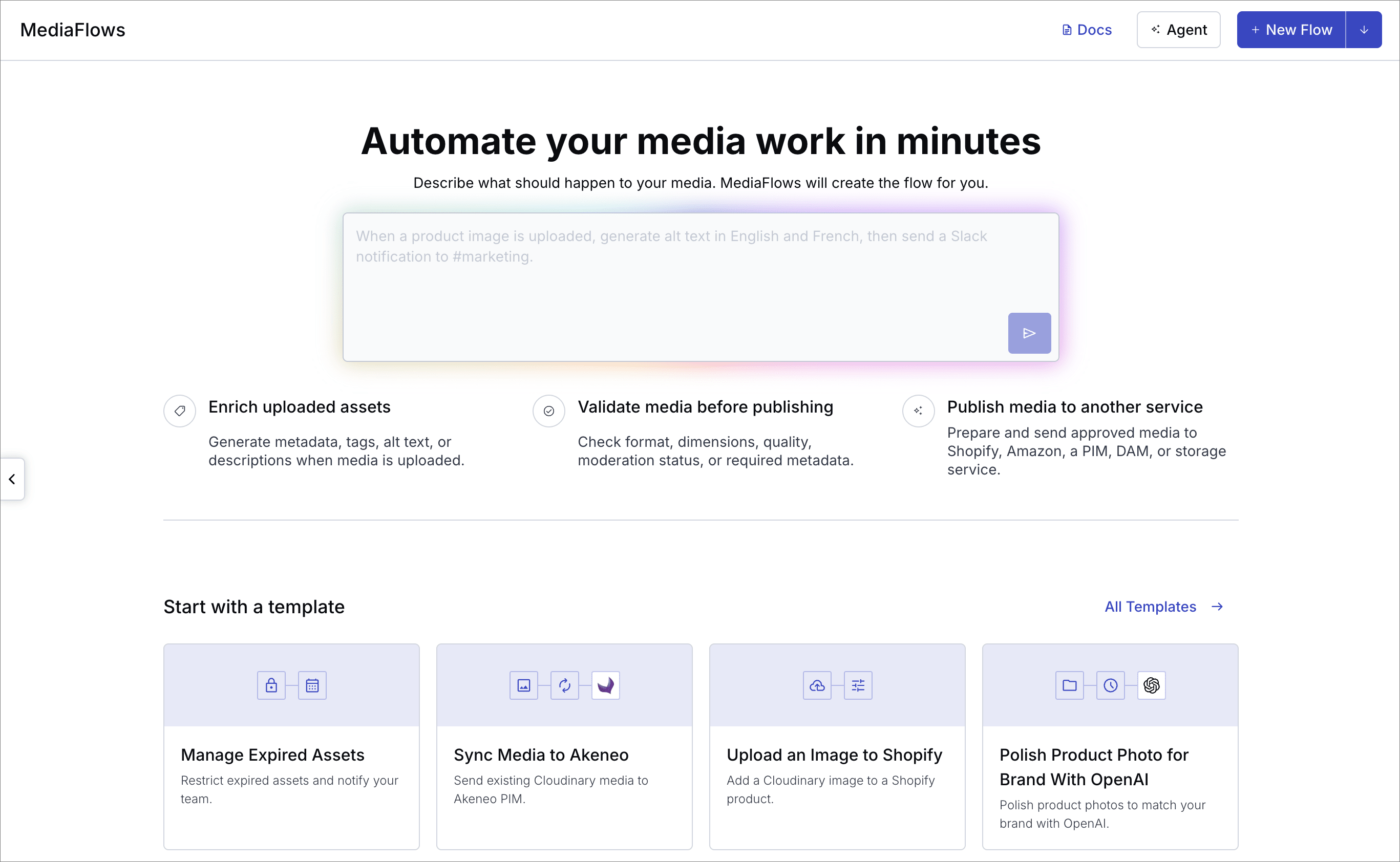
There are several ways to create a flow from the MediaFlows Home page:
- Describe it to the Workflow Agent: Enter what should happen to your media in the prompt box, and the Workflow Agent creates the flow for you. Click one of the example prompts below the box to fill in a prompt you can edit.
- Start with a template: Click one of the templates to see what it does, then click Use Template. Click All Templates to see the rest. See PowerFlow templates.
- Build it yourself: Click New Flow at the top of the page to create a PowerFlow, or click the arrow beside it and choose New PowerFlow, Build With Agent, Start With a Template, or New EasyFlow. New Flow is available at the top of every MediaFlows page.
Manage flows
In the Flows page, you can see all your PowerFlows and EasyFlows.
To narrow the list, search by flow name, or filter by Status (Active, Fix Required, or Not Active), by Type (Easy or Power), or to show only your Favorites. The number of matching flows is shown beside the filters. Your filter choices are remembered in your browser the next time you open the page.
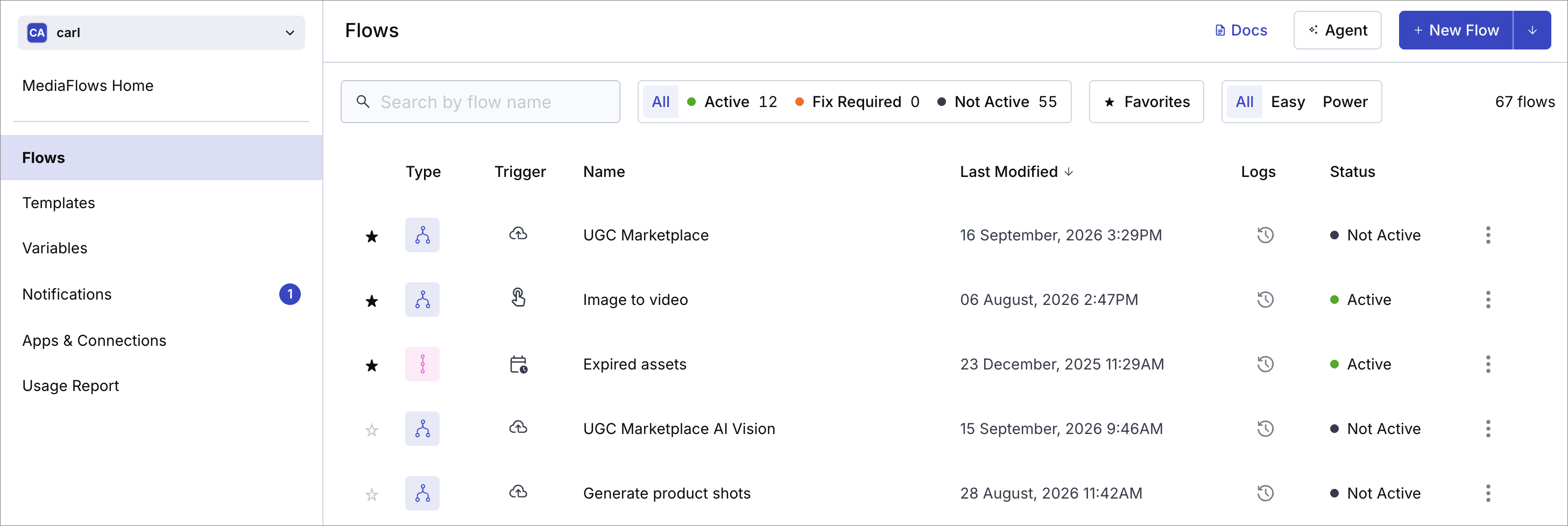
For each flow, you can open it, view its logs, and delete it.
PowerFlows also have other options that you can select via the (3-dots) menu:
- Flow Variables: User-defined variables that are accessible to the PowerFlow in which they're defined. Learn more.
-
Flow Secrets: Sensitive data, such as API keys and secrets, that are only accessible to the PowerFlows in which they're defined. Learn more.
Note that you can use Environment Variables to store data that's accessible to any of your PowerFlows.
- Duplicate: Creates a copy of the flow.
- Share: Creates a link to the flow, which you can share with colleagues using different product environments. Learn more.
- Flow Notification: Configures in-app and webhook notifications for flow execution success and failure. Learn more.
Apps & Connections
The Apps & Connections page is a central hub for managing the third-party app accounts that your flows use. Instead of entering credentials each time you configure a block, you connect your accounts once and then select the saved connection when building flows.

The page is divided into two areas:
- Overview: A summary of the total number of connected apps and accounts, and the number of flows that are using connections.
- Manage: A list of your connected apps. You can expand an app to see each individual account, how many flows it's used in, and whether it's enabled. Apps that are available but not yet connected appear under Discover.
Connect an account
To add a new account for a supported app:
- In the Manage section, find the app or locate it under Discover.
- Click Connect Your Account (or Add New Account if you already have at least one account connected for that app).
- Enter the credentials required for the app.
Once added, the account appears in the app's entry and is available for selection when configuring blocks that use that integration.
You can disable and enable an account using the toggle switch, or remove the account entirely by clicking Disconnect.
Use a connection in a block
Blocks that integrate with third-party apps include a connection field in the block's configuration panel.
Click Connect to select an account from the list of connected accounts for that app, or click Add a new account to connect an additional account without leaving the block editor.

Once configured, you can click Change to pick a different account.

Monitor usage
The MediaFlows Usage Report page shows an overview of your touchpoint usage for the current billing cycle and the total number of flows across all product environments.
You can also review touchpoint usage for previous billing cycles or specify custom date ranges to analyze trends over time.
Your usage includes:
- Touchpoints: The number of assets processed by your flows. Only assets that pass the trigger conditions are counted.
- Flows: The total number of flows across all product environments.
How MediaFlows calculates touchpoints
A touchpoint is how we charge for the work a flow does.
Every time your flow runs, we count how many Cloudinary assets (images, videos, files) it works with, whether it reads, creates, or changes them. Each asset is equal to one touchpoint.
Once a flow passes the trigger's filter, it always counts at least one touchpoint.
Examples:
- A flow triggers when a video is updated, then resizes that same video → one touchpoint.
- A flow triggers when an image is updated, searches for all images with the same SKU (finds five), then relates all of them → six touchpoints (the original + five).
- A flow triggers once a day and sends a Slack message to the team → one touchpoint (even though no asset was touched, every execution counts as at least one).
View notifications
The Notifications page collects the in-app notifications sent to you by flows in the product environment you're currently working in. Switching product environment shows that environment's notifications. There are two types of notification:
- Flow-level notifications, which are generated when a flow execution succeeds or fails. These are configured in Flow Notification settings.
- Asset-level notifications sent by a Notification block (now called Send MediaFlows Notification) during a flow. Multiple executions of the same block accumulate assets into a single notification.

The Notifications page shows:
- A list of asset-level notifications and flow-level notifications
- Filters to show all or unread only notifications, sorted by newest or oldest
View notification details
For flow-level notifications, click View logs to open the History Logs page for that flow.
For asset-level notifications, click the card to open the asset drill-down view, where you can see which flow and block generated the notification, open a preview of each asset, and open the assets in the Media Library.
You can view the assets in grid view:

or list view:

Set up notifications in a flow
To send asset-level notifications to yourself or other users in your Cloudinary account, add a Notification block (now called Send MediaFlows Notification) to your flow and configure:
- Asset to notify: the asset to include in the notification
- Notify: the users or user groups who receive the notification. Group members without access to the product environment aren't notified. When a trigger supports it, you can also notify the user who initiated the flow (for example, the user who uploaded the asset)
- Subject: a title for the grouped notification
- Message: optional additional context
- Asset message: an optional per-asset message shown in the detail view

To set up flow-level success and failure notifications, see Flow Notification settings.
- Learn how to build a PowerFlow
- Learn how to build an EasyFlow
- Let AI build your flows for you, using the MediaFlows MCP server
Error
Rate this page:
